
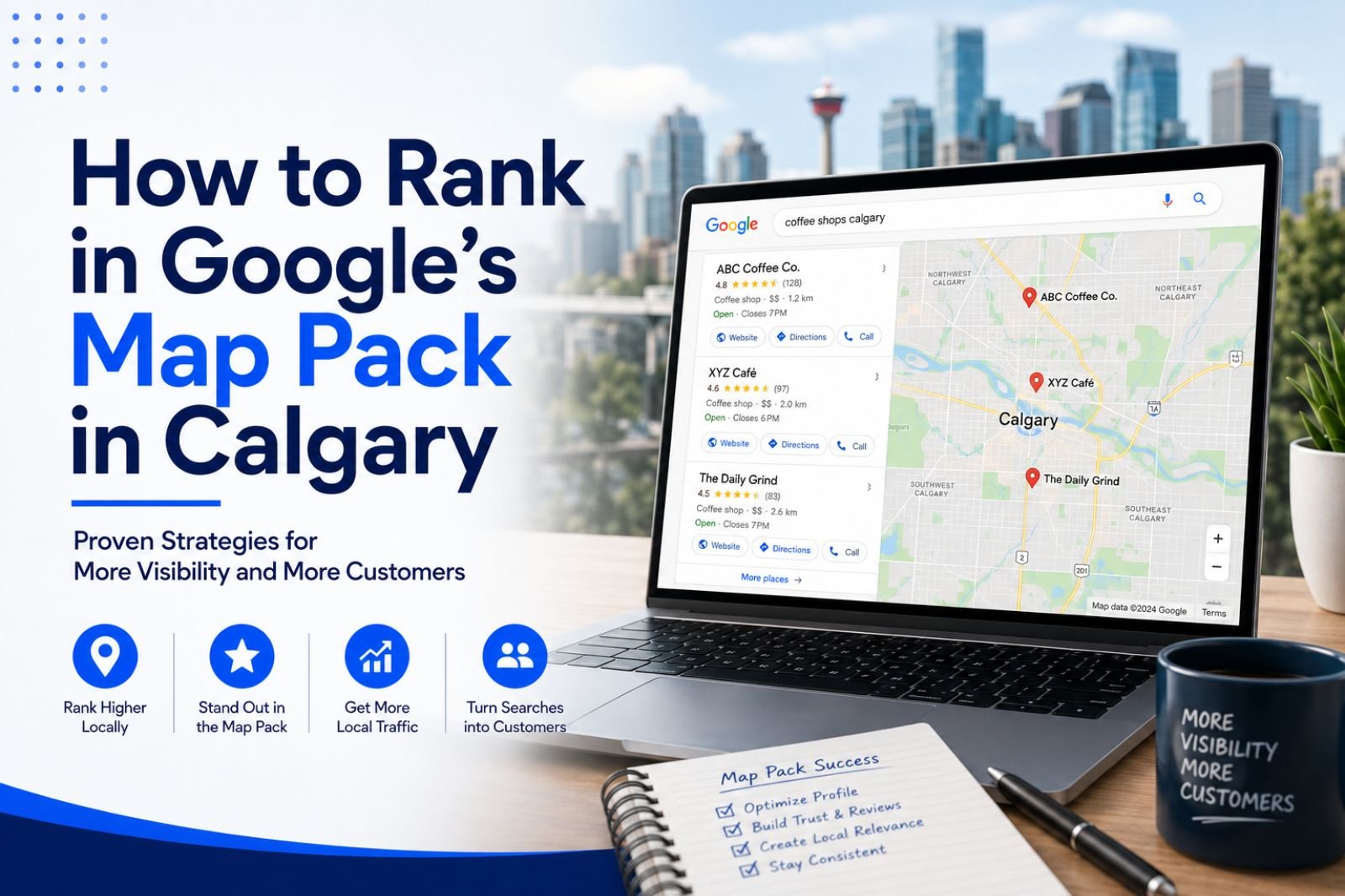
For most local searches in Calgary, three businesses get the lion’s share of the attention, and everyone else fights over what is left. Those three sit in the map pack, the block of local results with the map and the pins that shows up above the regular blue links. When someone searches “electrician near me” in Mahogany or “emergency plumber” from an office downtown, the map pack is what they look at first, and often the only thing they act on.
Getting into those three spots is one of the highest-value things a local business can do. The catch is that the map pack does not work like regular search, it runs on a separate algorithm, and a lot of the advice online is either outdated or flat wrong. This guide breaks down how Google actually decides who ranks in the local pack, why your competitor two neighbourhoods over might be beating you, and what genuinely moves you up in a market as busy as Calgary.
What is the Google map pack?
The map pack, also called the local pack or the 3-pack, is the group of three local business listings Google shows at the top of the results for a search with local intent. It sits above the organic links, it pulls its information from Google Business Profiles, and it is powered by a local ranking algorithm that is separate from the one ranking ordinary web pages.
Because it takes the top of the page and comes with star ratings, distance, and a call button, the map pack captures a large share of the clicks on any local search. If your business is not in it, most of that traffic is going to the three that are.
How Google decides who ranks in the map pack
Google keeps its public explanation short, and it has stayed consistent for years. Local results come down to three things: relevance, distance, and prominence. Everything else you read is really just a detail sitting under one of those three headings. Understanding them is the difference between chasing tricks and building something that holds.
Relevance is how well your profile matches what the person searched. This is driven heavily by your primary business category, the services you list, and the information on your profile and website. If someone searches for a “brake repair shop” and your profile says “auto repair shop,” you are less relevant than the shop that named the exact service. Relevance is the part you control most directly.
Distance is how close you are to the searcher, or to the area they typed into the search. This is the factor owners find most frustrating, because you cannot move your building. More on how to work around it below.
Prominence is how well known and trusted your business appears to be, in the real world and online. Reviews are a big part of it. So are links, mentions, citations, and how active and complete your presence is. A hardware store with hundreds of reviews and genuine local ties will usually outrank a closer shop with a thin, neglected profile.
Once you accept that framework, strategy gets simpler. You stop hunting for loopholes and start building proof that you are the most relevant, most trusted option in your area.
The proximity problem, and how Calgary businesses work around it
Here is the thing most people do not realize. There is no single map pack for Calgary. There are thousands of them. The results change based on exactly where the searcher is standing. A search from Signal Hill returns a different three than the same search from Forest Lawn, because Google is trying to show each person businesses near them.
That means a plumber based in the northwest is fighting an uphill battle to appear in the pack for someone searching from the deep southeast, no matter how good the profile is. Distance is doing its job. You cannot SEO your way to being physically closer.
What you can do is help Google understand where you genuinely serve and build enough prominence to widen your reach. A few things that work:
Set your service area accurately if you are a mobile or service-area business, and list the real communities you cover, whether that is Airdrie and Cochrane to the north or Okotoks and Chestermere to the south. Build separate, genuinely useful location pages on your website for the key areas you want to win, rather than one thin page trying to rank everywhere. And keep stacking prominence, because the stronger your reviews and overall footprint, the further out from your location Google is willing to show you. A business with real authority shows up across a wider radius than a weak one sitting in the same spot.
If you serve the whole city from one location, be realistic. You will rank strongest near your address and fade the further out a searcher is. Deciding which quadrants actually matter for your business, and concentrating your effort there, beats spreading yourself thin across all of Calgary.
Get your primary category right first
If you fix only one thing, fix this. Across the industry research that tracks local ranking factors year after year, the primary business category consistently lands at or near the top of the list of individual signals. It tells Google what you fundamentally are, and picking one that is too broad quietly caps how well you can rank.
Choose the most specific category that is genuinely accurate, then add secondaries for your other real services. We cover the full profile setup, including categories, services, and attributes, in our companion guide on Google Business Profile optimization for Calgary businesses. A strong profile is the asset. The map pack is the payoff.
Reviews: a moving target, not a magic number
People always want to know how many reviews they need to rank. The honest answer is that there is no fixed number, because the target moves depending on who you are competing against.
Reviews are one of the strongest prominence signals, and the number you need is relative. In a quiet suburban category you might break into the pack with twenty or thirty. In a competitive Calgary vertical like plumbing, HVAC, or dentistry, the businesses in the top three often carry well over a hundred, and matching them is the price of entry. There appear to be rough thresholds where things shift, around ten, twenty, fifty, and a hundred reviews, but what actually matters is where you sit against the specific competitors showing up for your searches.
A few things matter more than the raw count. Velocity and recency, meaning a steady flow of new reviews rather than a pile from two years ago followed by silence. Your average rating, since profiles sitting at four stars and up tend to perform better. And your response rate, because replying to reviews is itself a trust signal, and the businesses that respond to the large majority of theirs tend to do better than the ones that ignore them. When a customer mentions the actual service and neighbourhood in their review, that language quietly reinforces your relevance too, so it is worth making it easy for happy customers to leave a real, specific review right after the job.
Never buy reviews or post fake ones. Google is good at catching it, and a suspension erases years of work in an afternoon.
Make sure you are actually open
This one is easy to miss. Whether your business is shown as open at the moment someone searches has become a meaningful factor. Google would rather send a customer to a business they can reach right now.
Keep your hours accurate, set special hours for holidays and long weekends, and if you offer genuine after-hours or emergency service, make sure your profile reflects it. A trades business that answers the phone at 9pm has a real edge on the late-night “emergency” searches, but only if the profile tells Google that.
Your website and citations still pull weight
The map pack is powered by your profile, but it does not exist in a vacuum. On-page and citation signals from around the web carry real weight in the local algorithm.
Your name, address, and phone number need to be identical everywhere they appear online. A single inconsistent listing, an old suite number here or a former phone number there, fragments the entity in Google’s eyes and chips away at trust. Your website should clearly state where you are and what you do, with local landing pages for the areas that matter and content that backs up your relevance. If your profile is polished but your website is thin or your citations are a mess, you are capping your own ceiling. The two work as one system, which is why we treat them together in our local SEO work for Calgary businesses.
If your profile looks fine but you are still nowhere to be found, the underlying cause is often one of these signals being off. We walk through the usual culprits in why your business isn’t showing up on Google Maps.
Getting the click and the call
Google watches how people behave with your listing. Click-through rate, clicks to call, direction requests, and website visits from your profile all feed back into the algorithm as engagement signals. A profile that gets chosen and acted on looks better than one that gets shown and ignored.
You influence this with the things that make someone pick you: strong photos, a solid rating, a description that speaks plainly to what they need, and a clear reason to choose you over the listing beside you. Ranking gets you shown. Being genuinely compelling gets you clicked, and the clicks help you keep the ranking.
Myths that waste your time
Local SEO is full of advice that sounds reasonable and does nothing. A few worth putting down.
Google Posts do not directly lift your ranking. A controlled study by the local search research firm Sterling Sky tracked hundreds of keywords over nine weeks and found no ranking movement from posting. Posts are still worth doing, because they help click-through and give customers a reason to act, but treat them as a conversion tool, not a ranking lever.
Geotagged photos do nothing for local rankings. This one refuses to die, but Google strips the location data out of images when they are uploaded, and testing across dozens of locations found no effect. A former Google staffer confirmed it outright. Upload great photos because they earn clicks and trust, not because you geotagged them.
And keyword stuffing your business name, turning “Bow River Plumbing” into “Bow River Plumbing Best Emergency Plumber Calgary,” is a fast way to get reported and suspended. The short-term bump is not worth losing the profile.
The reality: your industry changes the math
Not every business ranks on the same recipe. The research that breaks local ranking factors down by industry shows the weightings shift quite a bit depending on what you do.
Home service and trades businesses lean heavily on proximity, which means service-area strategy and prominence matter enormously for them. Dental and healthcare practices see reviews carry outsized weight, so review volume, velocity, and rating do a lot of the heavy lifting. Businesses that depend more on website authority need their on-page and content game to be strong. If you run a Calgary trades company, a dental clinic, or an auto shop, your priorities are not identical, and a plan that ignores that is leaving results on the table.
You do not rank in one place, so track the whole area
Because the map pack changes with the searcher’s location, checking your ranking from your own office tells you very little. You might sit at number one from your desk and be invisible six kilometres away where half your customers actually are.
The right way to see it is a geo-grid, sometimes called a local heatmap, which checks your ranking from a grid of points across your service area and shows you exactly where you win and where you disappear. That map of your real visibility is what tells you which neighbourhoods to go after next and whether your work is paying off, far better than a single check from one spot.
Do not ignore the other maps
Google is still the giant, but local search is spreading out. Apple Maps has its own listing system through Apple Business Connect, and a growing share of people ask AI answer engines like ChatGPT, Perplexity, and Gemini for local recommendations. Those tools pull from your reviews, your profile, and your wider footprint. Claiming your Apple listing and keeping your information consistent everywhere is becoming part of the job, not an optional extra.
How long does it take to rank in the map pack?
Some signals move fast. A corrected category can shift rankings within days. NAP and on-page fixes usually take a few weeks to register. The prominence signals that decide competitive markets, mainly review velocity and a consistent, active presence, build over a few months. Most Calgary businesses that commit to steady work see real movement within a few months, with the strongest results going to the ones who keep at it rather than treating it as a one-time push. The map pack rewards consistency, and it quietly punishes businesses that go quiet.
Bringing it together
Ranking in Calgary’s map pack is not a trick, it is a case you build. Nail your relevance with the right category and services. Work with proximity instead of against it by being honest about where you serve and concentrating your effort. Stack prominence through steady reviews, consistent information across the web, a website that backs you up, and a profile that stays active. Do that with more discipline than the businesses around you, and the top three is where you land.
If you want to know exactly where you rank across the city today and what is holding you back, reach out to ClickSync. We will map your real visibility and tell you plainly what to fix first.
Frequently asked questions
How many reviews do I need to rank in the Calgary map pack?
There is no fixed number. What you need depends on your competitors. In a low-competition category, twenty to thirty reviews may be enough, while in competitive Calgary verticals like plumbing, HVAC, or dentistry, the top three often carry well over a hundred. Velocity, recency, your average rating, and your response rate matter as much as the raw count.
Why does my business rank in some parts of Calgary but not others?
Because there is no single map pack. Google shows results based on where the searcher is located, so you naturally rank strongest near your address and fade the further out someone searches. Building prominence and a clear service area helps widen how far Google is willing to show you.
Is the map pack different from regular Google search results?
Yes. The map pack runs on a separate local algorithm built around relevance, distance, and prominence, and it pulls from Google Business Profiles rather than ranking web pages the way organic results do. You can rank well in the map pack and poorly in organic, or the other way around.
Do Google Posts help me rank in the map pack?
Not directly. Controlled studies have found no ranking movement from posting. Posts still help by improving click-through and giving customers a reason to choose you, so they are worth doing as a conversion tool rather than a ranking tactic.
Can I pay Google to rank in the map pack?
No. Google states there is no way to pay for a better local position. You can run Local Services Ads or regular ads that appear near the pack, but the organic map pack spots are earned through relevance, distance, and prominence, not bought.
How long does it take to show up in the map pack?
Category fixes can work within days, and on-page and citation fixes within a few weeks. The review and activity signals that decide competitive markets build over a few months. Most businesses that stay consistent see meaningful movement within a few months.