
BLOG
- Home
- Blog
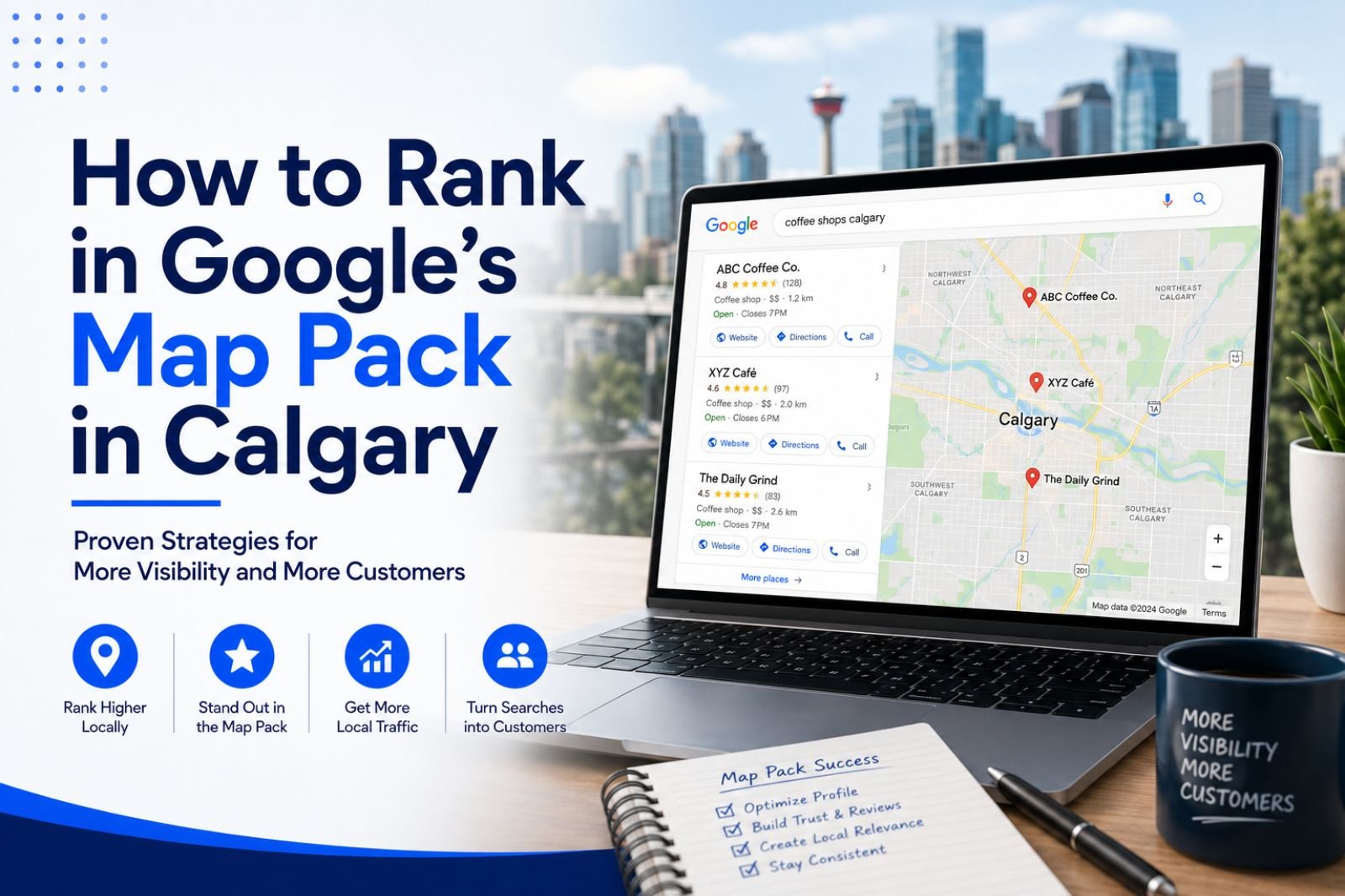
For most local searches in Calgary, three businesses get the lion’s share of the attention, and everyone else fights over what is left. Those three sit in the map pack, the block of local results with the map and the pins that shows up above the regular blue links. When someone searches “electrician near me” in Mahogany or “emergency plumber” from an office downtown, the map pack is what they look at first, and often the only thing they act on.
Getting into those three spots is one of the highest-value things a local business can do. The catch is that the map pack does not work like regular search, it runs on a separate algorithm, and a lot of the advice online is either outdated or flat wrong. This guide breaks down how Google actually decides who ranks in the local pack, why your competitor two neighbourhoods over might be beating you, and what genuinely moves you up in a market as busy as Calgary.
What is the Google map pack?
The map pack, also called the local pack or the 3-pack, is the group of three local business listings Google shows at the top of the results for a search with local intent. It sits above the organic links, it pulls its information from Google Business Profiles, and it is powered by a local ranking algorithm that is separate from the one ranking ordinary web pages.
Because it takes the top of the page and comes with star ratings, distance, and a call button, the map pack captures a large share of the clicks on any local search. If your business is not in it, most of that traffic is going to the three that are.
How Google decides who ranks in the map pack
Google keeps its public explanation short, and it has stayed consistent for years. Local results come down to three things: relevance, distance, and prominence. Everything else you read is really just a detail sitting under one of those three headings. Understanding them is the difference between chasing tricks and building something that holds.
Relevance is how well your profile matches what the person searched. This is driven heavily by your primary business category, the services you list, and the information on your profile and website. If someone searches for a “brake repair shop” and your profile says “auto repair shop,” you are less relevant than the shop that named the exact service. Relevance is the part you control most directly.
Distance is how close you are to the searcher, or to the area they typed into the search. This is the factor owners find most frustrating, because you cannot move your building. More on how to work around it below.
Prominence is how well known and trusted your business appears to be, in the real world and online. Reviews are a big part of it. So are links, mentions, citations, and how active and complete your presence is. A hardware store with hundreds of reviews and genuine local ties will usually outrank a closer shop with a thin, neglected profile.
Once you accept that framework, strategy gets simpler. You stop hunting for loopholes and start building proof that you are the most relevant, most trusted option in your area.
The proximity problem, and how Calgary businesses work around it
Here is the thing most people do not realize. There is no single map pack for Calgary. There are thousands of them. The results change based on exactly where the searcher is standing. A search from Signal Hill returns a different three than the same search from Forest Lawn, because Google is trying to show each person businesses near them.
That means a plumber based in the northwest is fighting an uphill battle to appear in the pack for someone searching from the deep southeast, no matter how good the profile is. Distance is doing its job. You cannot SEO your way to being physically closer.
What you can do is help Google understand where you genuinely serve and build enough prominence to widen your reach. A few things that work:
Set your service area accurately if you are a mobile or service-area business, and list the real communities you cover, whether that is Airdrie and Cochrane to the north or Okotoks and Chestermere to the south. Build separate, genuinely useful location pages on your website for the key areas you want to win, rather than one thin page trying to rank everywhere. And keep stacking prominence, because the stronger your reviews and overall footprint, the further out from your location Google is willing to show you. A business with real authority shows up across a wider radius than a weak one sitting in the same spot.
If you serve the whole city from one location, be realistic. You will rank strongest near your address and fade the further out a searcher is. Deciding which quadrants actually matter for your business, and concentrating your effort there, beats spreading yourself thin across all of Calgary.
Get your primary category right first
If you fix only one thing, fix this. Across the industry research that tracks local ranking factors year after year, the primary business category consistently lands at or near the top of the list of individual signals. It tells Google what you fundamentally are, and picking one that is too broad quietly caps how well you can rank.
Choose the most specific category that is genuinely accurate, then add secondaries for your other real services. We cover the full profile setup, including categories, services, and attributes, in our companion guide on Google Business Profile optimization for Calgary businesses. A strong profile is the asset. The map pack is the payoff.
Reviews: a moving target, not a magic number
People always want to know how many reviews they need to rank. The honest answer is that there is no fixed number, because the target moves depending on who you are competing against.
Reviews are one of the strongest prominence signals, and the number you need is relative. In a quiet suburban category you might break into the pack with twenty or thirty. In a competitive Calgary vertical like plumbing, HVAC, or dentistry, the businesses in the top three often carry well over a hundred, and matching them is the price of entry. There appear to be rough thresholds where things shift, around ten, twenty, fifty, and a hundred reviews, but what actually matters is where you sit against the specific competitors showing up for your searches.
A few things matter more than the raw count. Velocity and recency, meaning a steady flow of new reviews rather than a pile from two years ago followed by silence. Your average rating, since profiles sitting at four stars and up tend to perform better. And your response rate, because replying to reviews is itself a trust signal, and the businesses that respond to the large majority of theirs tend to do better than the ones that ignore them. When a customer mentions the actual service and neighbourhood in their review, that language quietly reinforces your relevance too, so it is worth making it easy for happy customers to leave a real, specific review right after the job.
Never buy reviews or post fake ones. Google is good at catching it, and a suspension erases years of work in an afternoon.
Make sure you are actually open
This one is easy to miss. Whether your business is shown as open at the moment someone searches has become a meaningful factor. Google would rather send a customer to a business they can reach right now.
Keep your hours accurate, set special hours for holidays and long weekends, and if you offer genuine after-hours or emergency service, make sure your profile reflects it. A trades business that answers the phone at 9pm has a real edge on the late-night “emergency” searches, but only if the profile tells Google that.
Your website and citations still pull weight
The map pack is powered by your profile, but it does not exist in a vacuum. On-page and citation signals from around the web carry real weight in the local algorithm.
Your name, address, and phone number need to be identical everywhere they appear online. A single inconsistent listing, an old suite number here or a former phone number there, fragments the entity in Google’s eyes and chips away at trust. Your website should clearly state where you are and what you do, with local landing pages for the areas that matter and content that backs up your relevance. If your profile is polished but your website is thin or your citations are a mess, you are capping your own ceiling. The two work as one system, which is why we treat them together in our local SEO work for Calgary businesses.
If your profile looks fine but you are still nowhere to be found, the underlying cause is often one of these signals being off. We walk through the usual culprits in why your business isn’t showing up on Google Maps.
Getting the click and the call
Google watches how people behave with your listing. Click-through rate, clicks to call, direction requests, and website visits from your profile all feed back into the algorithm as engagement signals. A profile that gets chosen and acted on looks better than one that gets shown and ignored.
You influence this with the things that make someone pick you: strong photos, a solid rating, a description that speaks plainly to what they need, and a clear reason to choose you over the listing beside you. Ranking gets you shown. Being genuinely compelling gets you clicked, and the clicks help you keep the ranking.
Myths that waste your time
Local SEO is full of advice that sounds reasonable and does nothing. A few worth putting down.
Google Posts do not directly lift your ranking. A controlled study by the local search research firm Sterling Sky tracked hundreds of keywords over nine weeks and found no ranking movement from posting. Posts are still worth doing, because they help click-through and give customers a reason to act, but treat them as a conversion tool, not a ranking lever.
Geotagged photos do nothing for local rankings. This one refuses to die, but Google strips the location data out of images when they are uploaded, and testing across dozens of locations found no effect. A former Google staffer confirmed it outright. Upload great photos because they earn clicks and trust, not because you geotagged them.
And keyword stuffing your business name, turning “Bow River Plumbing” into “Bow River Plumbing Best Emergency Plumber Calgary,” is a fast way to get reported and suspended. The short-term bump is not worth losing the profile.
The reality: your industry changes the math
Not every business ranks on the same recipe. The research that breaks local ranking factors down by industry shows the weightings shift quite a bit depending on what you do.
Home service and trades businesses lean heavily on proximity, which means service-area strategy and prominence matter enormously for them. Dental and healthcare practices see reviews carry outsized weight, so review volume, velocity, and rating do a lot of the heavy lifting. Businesses that depend more on website authority need their on-page and content game to be strong. If you run a Calgary trades company, a dental clinic, or an auto shop, your priorities are not identical, and a plan that ignores that is leaving results on the table.
You do not rank in one place, so track the whole area
Because the map pack changes with the searcher’s location, checking your ranking from your own office tells you very little. You might sit at number one from your desk and be invisible six kilometres away where half your customers actually are.
The right way to see it is a geo-grid, sometimes called a local heatmap, which checks your ranking from a grid of points across your service area and shows you exactly where you win and where you disappear. That map of your real visibility is what tells you which neighbourhoods to go after next and whether your work is paying off, far better than a single check from one spot.
Do not ignore the other maps
Google is still the giant, but local search is spreading out. Apple Maps has its own listing system through Apple Business Connect, and a growing share of people ask AI answer engines like ChatGPT, Perplexity, and Gemini for local recommendations. Those tools pull from your reviews, your profile, and your wider footprint. Claiming your Apple listing and keeping your information consistent everywhere is becoming part of the job, not an optional extra.
How long does it take to rank in the map pack?
Some signals move fast. A corrected category can shift rankings within days. NAP and on-page fixes usually take a few weeks to register. The prominence signals that decide competitive markets, mainly review velocity and a consistent, active presence, build over a few months. Most Calgary businesses that commit to steady work see real movement within a few months, with the strongest results going to the ones who keep at it rather than treating it as a one-time push. The map pack rewards consistency, and it quietly punishes businesses that go quiet.
Bringing it together
Ranking in Calgary’s map pack is not a trick, it is a case you build. Nail your relevance with the right category and services. Work with proximity instead of against it by being honest about where you serve and concentrating your effort. Stack prominence through steady reviews, consistent information across the web, a website that backs you up, and a profile that stays active. Do that with more discipline than the businesses around you, and the top three is where you land.
If you want to know exactly where you rank across the city today and what is holding you back, reach out to ClickSync. We will map your real visibility and tell you plainly what to fix first.
Frequently asked questions
How many reviews do I need to rank in the Calgary map pack?
There is no fixed number. What you need depends on your competitors. In a low-competition category, twenty to thirty reviews may be enough, while in competitive Calgary verticals like plumbing, HVAC, or dentistry, the top three often carry well over a hundred. Velocity, recency, your average rating, and your response rate matter as much as the raw count.
Why does my business rank in some parts of Calgary but not others?
Because there is no single map pack. Google shows results based on where the searcher is located, so you naturally rank strongest near your address and fade the further out someone searches. Building prominence and a clear service area helps widen how far Google is willing to show you.
Is the map pack different from regular Google search results?
Yes. The map pack runs on a separate local algorithm built around relevance, distance, and prominence, and it pulls from Google Business Profiles rather than ranking web pages the way organic results do. You can rank well in the map pack and poorly in organic, or the other way around.
Do Google Posts help me rank in the map pack?
Not directly. Controlled studies have found no ranking movement from posting. Posts still help by improving click-through and giving customers a reason to choose you, so they are worth doing as a conversion tool rather than a ranking tactic.
Can I pay Google to rank in the map pack?
No. Google states there is no way to pay for a better local position. You can run Local Services Ads or regular ads that appear near the pack, but the organic map pack spots are earned through relevance, distance, and prominence, not bought.
How long does it take to show up in the map pack?
Category fixes can work within days, and on-page and citation fixes within a few weeks. The review and activity signals that decide competitive markets build over a few months. Most businesses that stay consistent see meaningful movement within a few months.
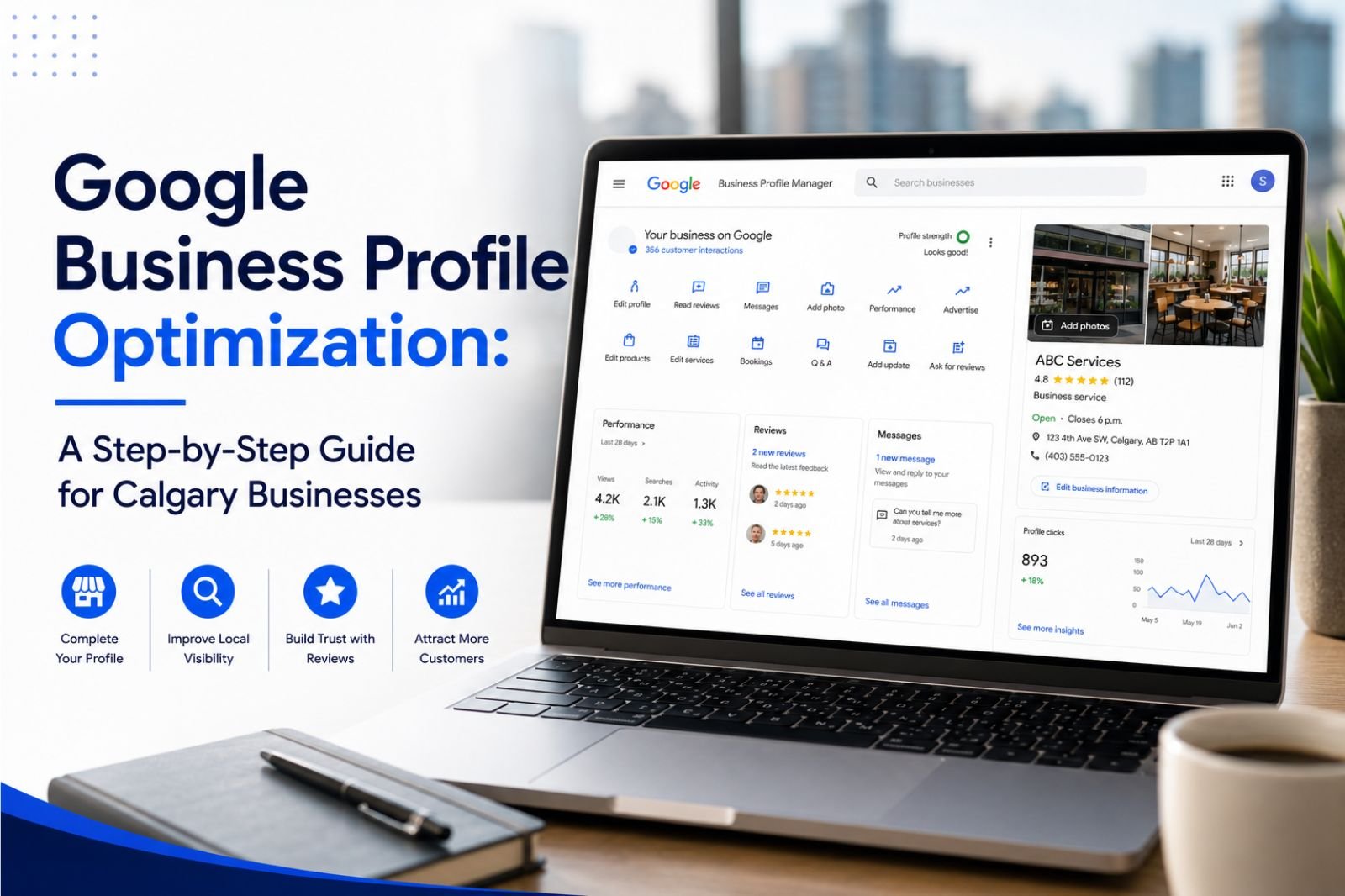
If you run a business in Calgary, your Google Business Profile is doing more selling for you than your website is. When someone in Bridgeland searches “plumber near me” or a family in the southwest looks up “dentist open Saturday,” the first thing they see is not a list of blue links. It is the map, the three businesses sitting in the local pack, and the star ratings next to them. That box is where local buying decisions get made, and getting into it is not luck. It comes down to how well your profile is built and how consistently you keep it active.
The tricky part is that Google Business Profile has changed a lot over the past two years, and most of the advice floating around is out of date. The Q&A section works differently now. Chat and call history are gone. Google’s AI reads your profile and answers customer questions before you ever get a chance to. So the old checklist of “fill in your hours and add a few photos” no longer cuts it in a market as competitive as Calgary.
This guide walks through what actually moves the needle right now, step by step, in the order we tackle it when we optimize profiles for local businesses across the city.
What Google Business Profile optimization actually means?
Google Business Profile optimization is the process of completing, refining, and regularly updating your free Google listing so it ranks higher in local search and Google Maps and turns more of those views into calls, direction requests, and website visits. It is not a one-time setup. Google rewards profiles that stay active, and it quietly demotes ones that go quiet.
Google decides who shows up in the local pack using three main factors: relevance, distance, and prominence. Relevance is how well your profile matches what the person searched. Distance is how close you are to the searcher or the area they named. Prominence is how established and active your business looks, which includes reviews, activity, and signals from around the web. You cannot move your storefront closer to every customer, but you have real control over relevance and prominence, and that is where optimization lives.
One shift worth flagging up front. Through 2026, Google has leaned harder on interaction and popularity signals, meaning the profiles that get clicked, called, and engaged with tend to hold their position better than profiles that simply look complete but sit idle. Activity is the game now.
Step 1: Claim and verify your profile
You cannot optimize what you do not control. Search your business name on Google and Maps to see if a profile already exists. Plenty of Calgary businesses have a listing that Google generated automatically or that a previous owner or agency set up, and they have never actually claimed it.
If you need to verify a new or unclaimed profile, expect video verification. Google now uses it as the default method for most new listings instead of the old postcard. You record a single continuous video that shows your signage or premises, the surrounding area, and proof that you manage the business, such as opening a drawer, using equipment, or logging into a point-of-sale system. Do it in one take with good lighting and you will usually pass the first time. Fumble it and you can get stuck in a review loop for weeks, which is a real problem when you are trying to launch.
If your business runs from a home base or serves customers at their location, like most trades and mobile services in Calgary, set yourself up as a service-area business and hide your street address. You still verify a real address with Google, but customers only see the areas you serve.
Step 2: Get your primary category exactly right
This is the single biggest lever you have, and most business owners get it wrong by being too broad.
Your primary category tells Google what you fundamentally are, and it carries more ranking weight than almost anything else you can edit. The mistake is choosing something general when a specific option exists. A clinic that picks “Dentist” leaves visibility on the table if what it really does is “Cosmetic dentist” or “Pediatric dentist.” A shop listed as “Auto repair shop” competes differently than one correctly set as “Auto body shop” or “Car detailing service.” Choose the narrowest category that is genuinely accurate.
Then add secondary categories for the other real services you offer. A garage door company might have “Garage door supplier” as primary and add “Repair service” secondary. Do not stuff categories that do not apply, because irrelevant ones can confuse Google and hurt you. The rule is simple. Primary is the one thing you most want to rank for. Secondaries cover the rest of what you actually do.
Step 3: Lock down your name, address, and phone number
Your name, address, and phone number, usually called your NAP, needs to be identical everywhere it appears online. That means your profile, your website, your Facebook page, your Yelp listing, and every directory and citation out there should show the exact same formatting. “Suite 280” in one place and “#280” in another, or an old cell number lingering on a directory, sends mixed signals to Google and chips away at the prominence you are trying to build.
Two rules that get people in trouble. First, your business name field should be your real business name, not “Best Calgary Plumber Fast Service.” Keyword stuffing the name violates Google’s guidelines and can get your profile suspended, which is a nightmare to recover from. Second, keep your hours genuinely accurate and set special hours for holidays. A customer who drives to your door on the Heritage Day long weekend because your profile said you were open, only to find you closed, is a customer who leaves a one-star review out of pure frustration.
If your business has moved or rebranded and you are seeing conflicting information across the web, that inconsistency is often the exact reason a profile struggles to rank. We dig into this in our guide on why your business isn’t showing up on Google Maps.
Step 4: Write a description that works for people and for AI
Your business description is a 750-character field, and it now does double duty. It speaks to the human reading your profile, and it feeds the AI that increasingly answers questions on your behalf.
Google offers an AI “suggest a description” tool inside your dashboard. Use it as a starting draft, never as the final version. The generic output it produces reads like every other listing. Rewrite it in plain language, work in what makes you different, and include the Calgary neighbourhoods or communities you serve. If you are a contractor covering the northwest, Airdrie, and Cochrane, say so. Specific and local beats vague and polished every time.
Lead with what you do and who you serve, then get to the details. Skip the marketing fluff and the empty superlatives. A description that plainly states “family-run electrical contractor serving Calgary and the surrounding communities of Airdrie, Chestermere, and Okotoks, specializing in panel upgrades and EV charger installation” gives both a customer and Google’s AI something concrete to work with.
Step 5: Fill out every service and attribute
Here is where the biggest change catches people off guard. The old Q&A section, where customers asked questions and owners answered, has been retired in favour of an AI feature that pulls answers from your profile, your services, your attributes, and your reviews. When someone asks whether you offer emergency service or whether your space is wheelchair accessible, Google’s AI answers instantly using whatever information it can find. If that information is not on your profile, the AI either guesses or says nothing, and both outcomes cost you.
So treat your Services and Attributes sections as the raw material the AI feeds on. List out every individual service with a short, specific description for each. Do not just list “Plumbing.” Break it into drain cleaning, water heater installation, leak repair, and so on. Each one is a chance to match a search.
Attributes are the checkboxes that describe your business: free parking, wheelchair accessible, women-owned, accepts credit cards, offers free estimates, and many others. Google adds new attributes regularly, and industry-specific ones appear as your category unlocks them, so check this section every couple of months. Complete attributes now directly influence whether your profile gets surfaced in AI-driven recommendations, so blank fields are missed opportunities.
Step 6: Photos and video that earn clicks
Profiles with strong, current photography get more engagement, and engagement is what holds your ranking. This is one of the most underused levers in local search.
Upload real photos of your actual work, your team, your storefront or vehicles, and your finished projects. Avoid stock imagery, because customers can smell it and it does nothing to build trust. For a Calgary business, seasonal photos help. Snow-and-ice work in January looks different from a summer patio install, and fresh images signal that your profile is being kept up.
Keep adding photos over time rather than dumping fifty on day one and never touching it again. A profile that quietly gains new images month after month reads as active and cared for. Short videos of a job in progress or a walk-through of your shop add another layer that many competitors skip entirely.
Step 7: Build reviews the right way
Reviews are one of the strongest prominence signals there is, and how you earn them matters more than most people think.
Velocity beats volume. A steady stream of reviews arriving week after week is worth more than a sudden burst of thirty followed by six months of silence. That pattern of one big push then nothing can actually look unnatural. So build a simple, repeatable habit of asking every happy customer, ideally right after the job is done and the good feeling is fresh. A quick text with a direct link to your review form removes the friction. Never buy reviews or post fake ones. Google is good at catching them, and the penalty is not worth it.
Respond to every review, the glowing ones and the critical ones. Responding is itself a signal that you are engaged, and the vast majority of businesses never bother, which means it is a cheap way to stand out. When you reply, be human and specific. Thank people by name where appropriate and reference the actual job. For a negative review, stay calm, take it offline, and show future readers that you handle problems like a professional. People read the owner responses closely, and a measured reply to an unfair review often does more good than the review does harm.
Step 8: Post regularly with Google Posts
Google Posts let you publish updates, offers, and events straight to your profile, and they show up in your listing on Search and Maps.
Be clear on what they do. Posts are not a direct ranking factor. They will not by themselves push you up the pack. What they do is drive engagement and clicks, and they give a potential customer a reason to choose you over the business beside you. Treat them as conversion tools. Announce a seasonal promotion, a new service, a completed project, or a limited-time offer. A furnace company running a fall tune-up special or a landscaper promoting spring cleanups is giving Calgary customers a timely nudge at exactly the right moment.
Aim for something new roughly once a week. Consistency here also feeds the freshness signal, which brings us to the step people forget.
Step 9: Turn on bookings and actions
Google increasingly favours profiles that let customers act without leaving the search results. If your business type supports it, connect a booking or appointment system so people can schedule directly from your profile. Google integrates with a range of scheduling platforms, and a booking button lowers the barrier between “interested” and “booked.”
For businesses that run on phone calls, make sure your call button points to a number you actually answer during your posted hours. It sounds obvious, but a missed call is a lost lead, and Google notices how you convert the intent it sends you.
Step 10: Keep it fresh and read your insights
Optimization is not something you finish. A profile that goes quiet for a month or more starts to look stale, and stale profiles slide. Google does not publish a hard rule on this, but the pattern is consistent enough that treating your profile like a garden rather than a filing cabinet is the safe approach. Add a photo, publish a post, update a service, respond to reviews. Small regular touches keep you looking active.
Then actually read your Performance insights, because they tell you what is working. The reporting now splits your impressions by where they came from: the classic local panel, the Maps AI summary card, and Google’s AI Overviews in the main search results. That breakdown shows how much of your visibility is coming from AI-driven surfaces, which is a growing share and worth watching.
Look past raw view counts to the actions. Calls signal someone ready to book. Direction requests signal intent to visit. Website clicks signal research. A profile with fewer views but a high action rate is outperforming one with big view numbers and little follow-through. Track the ratio, not the vanity number.
Common mistakes we see Calgary businesses make
A few patterns come up again and again when we audit local profiles.
Choosing a category that is too broad, and leaving specific ones on the table. Letting NAP information drift out of sync across the web after a move or a phone change. Setting up the profile once and never posting, never adding photos, never responding to reviews. Stuffing keywords into the business name and risking suspension. Ignoring the Services and Attributes sections, which now feed the AI answering customer questions. And forgetting holiday hours, which turns a small oversight into a bad review.
Every one of these is fixable, and fixing them is usually the fastest visibility win available to a local business.
How long does Google Business Profile optimization take to work?
Some changes register quickly. A corrected category or a fixed NAP can start shifting things within a couple of weeks. Prominence signals like review velocity and consistent activity build over months, not days. Most Calgary businesses that commit to steady, ongoing profile management see meaningful movement in the local pack within a few months, with results compounding the longer they stay consistent. The businesses that treat it as a one-time task rarely hold whatever gains they get.
Where this fits in your bigger local strategy?
A well-run Google Business Profile is the foundation of local visibility, but it works best alongside a strong website, consistent local citations, and content that reinforces what you do and where you do it. If your site is thin or your business information is scattered across the web, even a perfect profile will struggle to reach its ceiling. The two support each other, which is why local SEO treats them as one system rather than separate tasks. If you want to see how the pieces connect, our local SEO and search work covers the full picture.
Optimizing a profile once is straightforward. Keeping it optimized, week after week, while running your actual business, is where most owners run out of time. That ongoing work is exactly what our Google Business Profile management service handles.
If you would like a straight answer on where your profile stands today and what is holding it back, get in touch with our ClickSync. We will take a look and tell you plainly what to fix first.
Frequently asked questions
How much does it cost to optimize a Google Business Profile?
The profile itself is free to create and manage. Optimization costs come down to whether you do the ongoing work yourself or bring in help. The listing, the verification, and every feature covered in this guide carry no fee from Google.
Is Google Business Profile the same as Google My Business?
Yes. Google My Business was the old name. Google rebranded it to Google Business Profile and moved most management directly into Google Search and Maps, so you often edit your profile straight from search results rather than a separate dashboard.
How often should I update my Google Business Profile?
Check reviews and questions weekly, publish a post about once a week, and add fresh photos regularly. Review your core information, hours, and services monthly. A profile that goes more than a month without any activity starts to look stale and can lose ground.
Why is my Calgary business not showing up in the map pack?
The most common causes are a category that is too broad, inconsistent name, address, and phone details across the web, too few recent reviews, and a profile that has gone inactive. Distance from the searcher also plays a role, which is why relevance and prominence matter so much for reaching people across a large city.
Do Google Posts help my ranking?
Not directly. Posts drive engagement and give customers a reason to choose you, which supports your overall activity and conversions, but they are not a standalone ranking factor. Treat them as conversion tools rather than a shortcut to a higher position.
What happened to the Q&A section on my profile?
Google retired the manual Q&A feature in favour of an AI-driven system that answers customer questions automatically using your profile, services, attributes, and reviews. The best way to control those answers now is to make sure all of that information is complete and accurate.
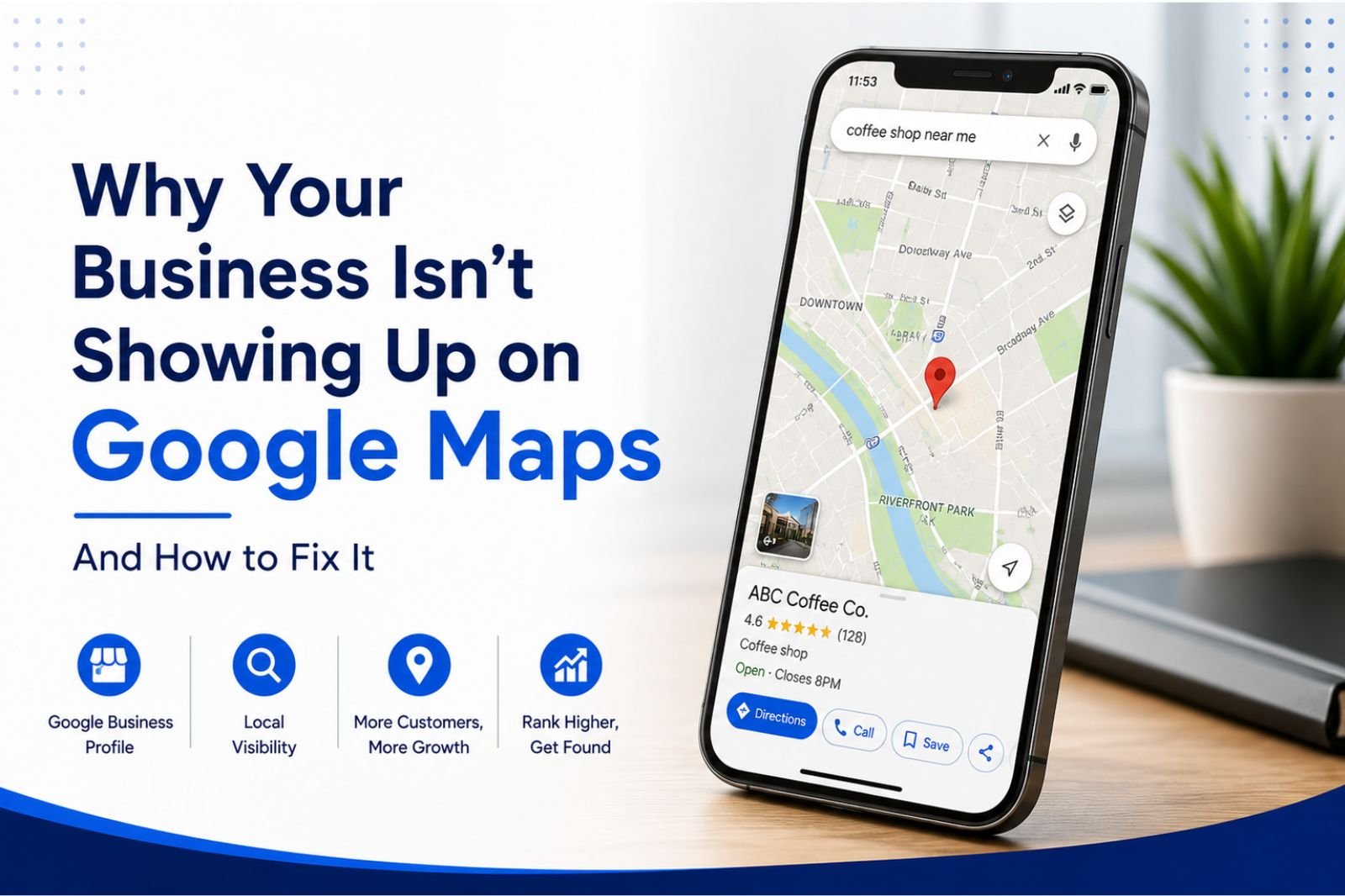
You search your own business name on Google. Nothing. Or worse, you find it, but it’s buried under five competitors you’ve never even heard of. Meanwhile your phone isn’t ringing the way it used to, and you’re starting to wonder if something is broken.
If you run a business in Calgary and you’ve typed “why isn’t my business showing up on Google Maps” into a search bar at some point this year, you’re not alone. This is one of the most common problems we run into when we start working with local businesses, and almost every time, the cause comes down to one of a handful of fixable issues.
This guide walks through the real reasons businesses disappear from Google Maps, how to check which one applies to you, and what to do about each one. No fluff, just the stuff that actually moves the needle.
How Google Maps Actually Decides Who Shows Up
Before fixing the problem, it helps to understand what Google is doing behind the scenes. Google Maps rankings (often called the Local Pack or Map Pack) are built on three main factors:
Relevance – how well your business profile matches what the person is searching for.
Distance – how close your business is to the searcher or the location they typed in.
Prominence – how well known and trusted your business is, based on reviews, links, citations, and overall online activity.
When your business isn’t showing up, it means you’re losing on one or more of these three factors compared to the businesses that are showing up. The good news is that two out of three (relevance and prominence) are almost entirely within your control.
Reason 1: Your Google Business Profile Isn’t Verified or Is Suspended
This is the most basic issue, and it trips up more businesses than you’d expect. If your Google Business Profile was never verified, or if it got suspended at some point, it will not appear in Maps results at all, no matter how good everything else looks.
How to check: Search your business name directly in Google. If a knowledge panel doesn’t appear on the right side of the search results, or if you see a message about the listing being unclaimed, that’s your answer.
Suspensions usually happen because of a few common triggers: using a virtual office or residential address that doesn’t match the listing category, stuffing keywords into the business name field, or having inconsistent information across the web (more on that below).
The fix: Claim your profile through Google Business Profile Manager if it’s unclaimed. If it’s suspended, you’ll need to file a reinstatement request through Google’s support form and clean up whatever triggered the suspension first, otherwise the appeal usually gets denied again. If you’d rather not deal with the back and forth, this is exactly the kind of cleanup our Google Business Profile management service handles for Calgary businesses.
Reason 2: You’re Not in the Right Category
Google leans heavily on your primary business category to decide which searches you’re relevant for. A surprising number of Calgary businesses are sitting in a category that’s either too broad, too narrow, or just plain wrong.
For example, a garage door repair company set to “General Contractor” instead of “Garage Door Supplier” is going to lose almost every relevant search to a competitor who picked the correct category. Same goes for a dental clinic listed as “Doctor” instead of “Dentist,” or a roofing company under “Construction Company” instead of “Roofing Contractor.”
The fix: Go into your Business Profile and check your primary category first, since that one carries the most weight. Then add secondary categories that reflect everything you actually do. Be specific. Google has thousands of categories, and the closer you get to an exact match, the better your relevance signal.
Reason 3: Your NAP Information Is Inconsistent
NAP stands for Name, Address, and Phone number. If these details are different across your website, your Google Business Profile, Facebook, Yelp, and other directories, Google has a harder time trusting that your business is legitimate and where it says it is.
This happens more often than people think. A business moves locations and updates their website but forgets Yellow Pages. A phone number changes and three directories never get the memo. A business name gets shortened on one platform and stays formal on another (think “AB Plumbing Ltd.” versus “AB Plumbing”).
The fix: Run a search for your business name across Google, Bing, Facebook, Yelp, and any major Canadian directories you’re listed on. Write down exactly what’s listed for your name, address, and phone number on each one. Then standardize everything to match precisely what’s on your Google Business Profile, right down to abbreviations like “St.” versus “Street.”
Reason 4: You Don’t Have Enough Reviews (Or Recent Ones)
Review count and review recency are two of the strongest prominence signals Google uses for local rankings. If your last review is from two years ago, or if you only have four reviews while your top competitor has ninety, that gap is working against you every single day.
It’s not only about the star rating either. Google reads the content of your reviews to understand what services you offer and what neighborhoods you serve, since customers often mention these naturally in their own words.
The fix: Build a simple, repeatable system for asking happy customers for reviews right after a job is completed or a sale is closed. A text message with a direct link to your review page, sent within 24 hours of service, will outperform almost any other method. Don’t buy reviews or incentivize them with discounts, since this violates Google’s policies and can get your profile suspended.
Reason 5: Your Service Area Setup Is Wrong
If you run a service area business, meaning you go to customers rather than having them come to you (think plumbers, HVAC techs, mobile detailers), your service area settings in Google Business Profile matter a lot more than people realize.
A common mistake is leaving the service area blank, setting it too wide (claiming all of Alberta when you really only serve Calgary and a few surrounding towns), or hiding your address when you actually do have a storefront customers can visit.
The fix: Set your service area to the specific cities and regions you genuinely serve, such as Calgary, Airdrie, Chestermere, Okotoks, and Cochrane, rather than the entire province. If you have a physical location customers can walk into, make sure that’s reflected accurately rather than hidden.
Reason 6: You Have Little to No Local Citations
Citations are simply mentions of your business name, address, and phone number on other websites, even without a link back to your site. Local directories, industry associations, and Canadian business listing sites all count.
Citations work as trust signals. If Google sees your business listed consistently across a healthy number of legitimate sources, it reinforces that you’re a real, established business in the area you claim to serve.
The fix: Get listed on core Canadian directories such as Yelp Canada, Yellow Pages Canada, Better Business Bureau, and any industry-specific directories relevant to your trade. Make sure every listing uses identical NAP information to avoid creating the inconsistency problem mentioned earlier.
Reason 7: Your Website Doesn’t Support Your Local Relevance
Your Google Business Profile doesn’t operate in isolation. Google cross-references it against your website to confirm everything lines up. If your website never mentions Calgary, doesn’t list your service areas, or lacks basic local signals like a visible address and phone number, it weakens the overall picture Google has of your business.
The fix: Make sure your homepage and key service pages clearly mention the city and neighborhoods you serve. Add your NAP information to your footer on every page. If you serve multiple areas, consider dedicated location pages rather than trying to cram every city into one paragraph.
Reason 8: You’re Brand New and Haven’t Built Prominence Yet
Sometimes the honest answer is simply that your business is new, and prominence takes time to build. Google doesn’t fully trust a profile that was created last month the same way it trusts one that’s been active and engaged for three years.
This doesn’t mean you’re stuck waiting. It means your early focus should go into the factors you can influence fastest: getting your first wave of genuine reviews, making sure your profile is complete in every section, and posting regular updates to show Google the profile is actively managed.
The fix: Treat the first 90 days as a foundation-building period. Complete every field in your Business Profile, including services, attributes, and business description. Post updates weekly. Respond to every review, even the three-star ones. Consistency here compounds over time.
A Quick Way to Check Where You Stand
If you want a fast gut check before doing a full audit, ask yourself these questions:
- Is your Google Business Profile fully verified and active?
- Is your primary category the most specific and accurate option available?
- Does your NAP match exactly across your top five online listings?
- Have you received at least one new review in the last 30 days?
- Is your service area set to your actual coverage zone, not the whole province?
- Are you listed on at least five legitimate local directories?
- Does your website mention Calgary and your service areas clearly?
If you answered no to two or more of these, that’s likely where your visibility gap is coming from.
Final Thoughts
Showing up on Google Maps isn’t about gaming the system. It’s about giving Google clear, consistent, trustworthy signals that your business is real, relevant, and active in the area you serve. Most of the businesses we talk to in Calgary are losing visibility to one or two fixable issues, not some mysterious algorithm penalty.
Start with the checklist above, fix what you can today, and build the rest into an ongoing habit rather than a one-time cleanup.
If you’d rather have a second set of eyes on it, we offer a free Google Maps and Business Profile audit for Calgary businesses. We’ll show you exactly what’s holding your listing back and what to prioritize first, no obligation attached.