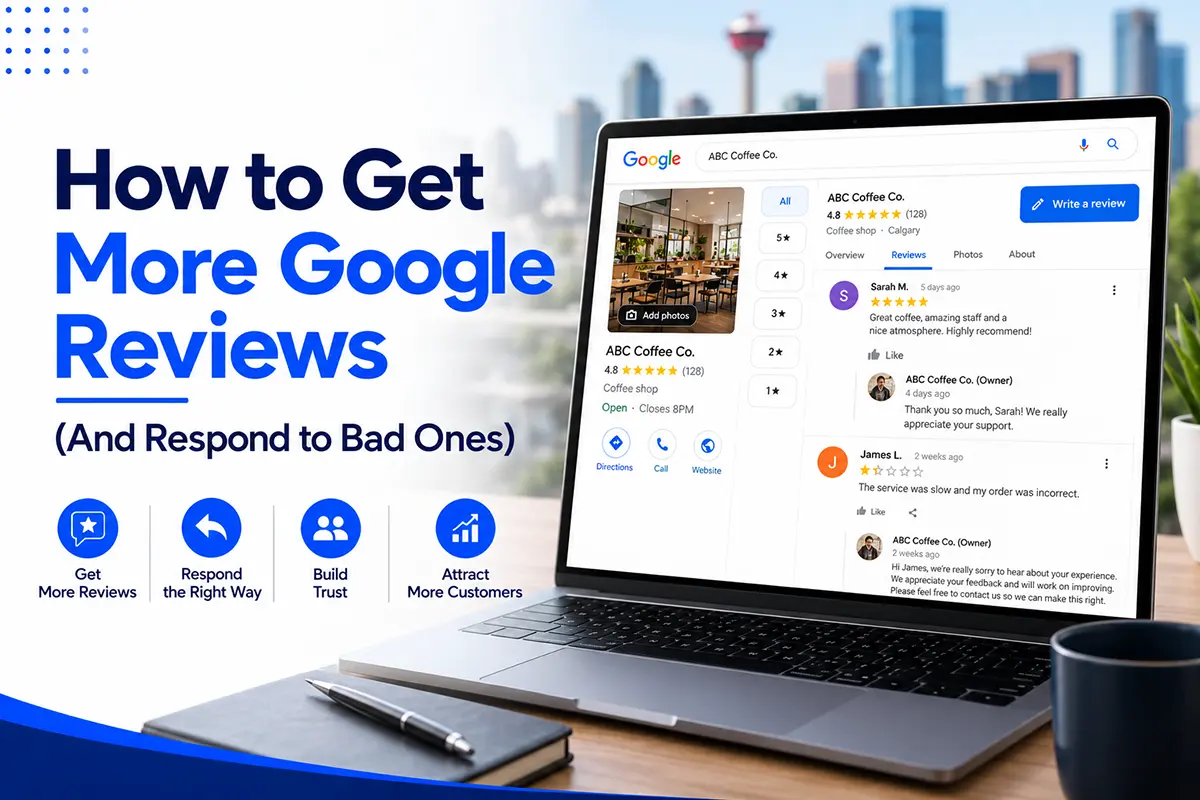
Reviews are the closest thing a local business has to a reputation you can measure. They shape whether someone picks you off the map, they feed directly into how Google ranks you, and increasingly they feed the AI tools that recommend businesses when people ask for one. For a Calgary business competing against a dozen similar shops, the review profile is often the tiebreaker.
Here is the part that catches people off guard. Google changed the rules in April 2026, and a lot of the review tactics that agencies and software vendors sold as best practice for years are now policy violations. Businesses have watched review counts drop without any notification, and many still do not know why. If you are collecting reviews the way most people were taught, there is a real chance your process is now offside.
This guide covers what changed, how to get more reviews the right way, the Canadian rules on emailing and texting your customers that most articles ignore completely, and how to handle a bad review without making it worse.
Why Google reviews matter more than ever
Reviews sit inside what Google calls prominence, one of the three pillars of local ranking alongside relevance and distance. It is one of the strongest signals you can actually influence, and its weight in the local algorithm has grown over the past few years rather than shrunk.
But the ranking benefit is only half of it. Reviews also decide whether the person who sees you actually calls. Two businesses side by side in the map pack, one at 4.8 with a hundred and fifty reviews and one at 4.2 with eleven, is not a close contest. And with AI tools now recommending local businesses, your reviews are part of the source material those systems read when deciding who to name.
For a fuller picture of how reviews fit alongside the other ranking factors, our guide on how to rank in Google’s map pack in Calgary breaks the whole system down.
If you are looking for a professional Google business profile management company in Calgary to grow your presence locally, ClickSync is your Local agency based in SouthEast Calgary.
What Google banned in April 2026
On April 16 and 17, 2026, Google updated the rating manipulation section of its Maps user generated content policy and started enforcing existing rules far more aggressively. Google’s systems blocked or removed hundreds of millions of policy-violating reviews in 2025, and the same machinery is now applying the tighter language. Reviews began disappearing in the days that followed, often in batches, usually with no warning to the business.
Here is what is now clearly off limits.
Review gating. This is the big one. Gating means filtering customers by sentiment before you send the review link. The usual setup asks for a private rating first, sends the happy customers to Google and routes the unhappy ones to an internal feedback form. The logic feels sensible, which is exactly why it spread so widely. It has always been against Google’s policy, and now it is actively enforced. Every customer has to get the same opportunity to review you publicly.
Asking for reviews while the customer is on your premises. Verbal requests at the counter, tablets in the waiting room, and review kiosks are now explicitly prohibited. Any setup where a customer leaves a review on a device you own is a violation.
Review quotas for staff. Telling your team you need ten reviews this week, or running a leaderboard for which advisor collects the most, is now written into the policy as a violation.
Asking customers to mention specific content. This includes directing customers to name a particular technician or mention a particular service. To be precise, Google did not ban reviews that happen to mention an employee. A customer naming your tech on their own is completely fine. What is banned is you instructing them to do it. The problem is that Google’s classifier sees the pattern, and clusters of short five-star reviews all naming staff look exactly like manipulation, so they get pulled.
Incentives of any kind. Discounts, gift cards, free upgrades, loyalty points, entry into a draw. Offering anything of value in exchange for a review has always been prohibited, including offering something to get a negative review revised or removed.
Google still wants you to collect reviews. What it permits is asking customers to share a genuine experience, without an incentive attached and without trying to steer the rating or the content. That is a narrower lane than most businesses have been operating in, but it is a workable one.
The compliant way to get more reviews
Strip away everything Google now bans and what remains is actually simpler than what most businesses were doing. One neutral request, sent to every customer after the work is done, at a steady pace.
Ask everyone, not just the happy ones. This feels risky and it is the single most important change. Once you stop filtering, you might expect your rating to fall. In practice it usually does not, because satisfied customers are the majority for any business doing decent work, and they are the ones who respond. What you get instead is a natural distribution that looks credible. A perfect five point zero with sixty reviews reads as suspicious to a lot of people. A 4.7 with two hundred reads as real.
Send it after they leave, not while they are there. The request should land once the customer has gone, by text or email. Immediately after service completion works best, while the experience is fresh.
Keep the language open. Something like “we would appreciate it if you shared your experience” works. Avoid anything that steers, such as asking for five stars, asking them to mention a specific tech, or asking them to mention a specific service.
Make it one tap. Every extra step loses people. Use your direct Google review link so the customer lands on the review box rather than having to search for you and hunt for the button. You can generate this from your Business Profile.
Build it into the job, not into a campaign. The businesses with the strongest review profiles are not the ones who run a review push twice a year. They are the ones where the request goes out automatically after every single job, quietly, forever. Steady beats bursts, and a slow consistent drip also looks far more natural to Google than fifty reviews landing in one week.
Text tends to beat email. Open rates on SMS are dramatically higher and the response usually comes within minutes. Email still has a place, especially for B2B or higher-value work where a slightly longer message makes sense. Which brings us to a rule that most articles on this topic skip entirely.
The Canadian rule most review guides ignore
If you are in Calgary and you are texting or emailing customers to ask for reviews, Canada’s anti-spam legislation applies to you. CASL governs commercial electronic messages sent to people in Canada, and the penalties for getting it wrong are not trivial. Almost every article you will read on getting reviews is written for a US audience and does not mention this at all.
The short version. You need consent, and it comes in two forms. Express consent is when someone has actively agreed to receive messages from you. Implied consent covers the situation most businesses are actually in, and it comes from an existing business relationship. If a customer purchased a product or service from you, or entered a contract with you, you have implied consent for two years from that transaction. If someone made an inquiry or submitted an application but has not bought anything, you have six months.
So for a customer whose furnace you serviced last month, you are inside the window. For someone you have not worked with in three years, you are not.
There are other requirements too. Your messages need to identify who you are with valid contact information, and they need a working unsubscribe mechanism. If someone opts out you have to stop within ten business days. You also need to keep records that prove you had consent, which is where a lot of businesses come undone, because a phone number scribbled on a work order with no date attached is not evidence of anything.
One point worth being careful about. Interpretations differ on whether implied consent is sufficient for SMS or whether express consent should be the standard, and some platforms take the stricter view. The safe route is to collect express consent at the point of sale. A simple checkbox or a line on your intake form saying the customer agrees to receive messages from you, with the date recorded, removes the ambiguity entirely and takes ten seconds to set up.
This is general information rather than legal advice, and if you are running high volume outreach it is worth a conversation with someone qualified. But the practical takeaway is straightforward: ask recent customers, keep dated records of consent, always include a way to opt out, and do not dig into a list of contacts from five years ago.
A tool that handles the sending for you
Knowing the right process and actually running it after every job are two different problems. Most owners we talk to know they should be asking. What stops them is that at the end of a long day, sending individual requests is the thing that falls off the list.
At ClickSync Marketing we built a tool for exactly this. It lets you send review requests to your existing customers by email and SMS, so the ask goes out reliably instead of depending on someone remembering. It is scoped to Google reviews specifically, it sends the same neutral request to every customer rather than filtering anyone out, and it is built around the Canadian consent and unsubscribe rules rather than a US template. That combination matters more now than it did a year ago, because a tool that still runs sentiment filtering is a tool that puts your profile at risk.
If you want to see how it works for your business, get in touch with our ClickSync team and we will walk you through it.
How to respond to a bad review?
Every business gets one eventually. The instinct is either to ignore it or to fire back, and both are mistakes.
Understand who you are actually writing for. You are not writing to the angry customer, who has already made up their mind. You are writing to the next fifty people who read that review while deciding whether to call you. Those readers are not really judging the complaint. They are judging how you handle it. A calm, specific, human response underneath a harsh review often does more for your credibility than another five-star review would.
Wait before you write. Not days, but long enough to lose the heat. Nothing published in anger has ever helped.
Respond publicly, then move it private. Acknowledge the specific issue, take responsibility for whatever part is genuinely yours, and offer a direct way to sort it out. Something along the lines of: you are sorry the install ran late, that is not the standard you hold yourself to, and here is the number to reach you directly. Short is fine. Two or three sentences usually beats a paragraph.
Do not argue the facts in public. Even when you are right, a point by point rebuttal reads as defensive to every stranger who sees it. If the review is inaccurate you can correct the record briefly and neutrally, then move on.
Never offer anything to get it removed. Offering a refund or a discount in exchange for taking down a review is a policy violation on its own. You can absolutely make things right with a customer. You just cannot make the fix conditional on them changing the review.
Do not skip the good ones. Responding to positive reviews is itself a trust signal and most businesses never bother, which makes it a cheap way to stand out. Keep it brief and specific. Referencing the actual job beats a copy-pasted thank you, and readers can tell the difference instantly.
When you can get a review removed?
Sometimes a review genuinely breaks the rules and you can flag it. Reviews from competitors, from current or former employees, and from people who were never customers are prohibited. So is content that is off topic, contains hate speech or personal attacks, includes personal information, or is clearly spam.
What you cannot get removed is a review that is simply unfair or that you disagree with. A customer who had a bad day and rated you two stars for something outside your control is still expressing a genuine experience. Flag what actually violates policy, and for everything else, respond well and bury it under a steady flow of newer reviews.
That is the real defence against a bad review. Not removal, but volume and recency. One angry review against fifteen total is a problem. The same review sitting under a hundred and eighty is barely visible.
How many reviews do you actually need?
There is no fixed number, because the target depends entirely on who you are competing against. In a quiet category you might do fine with thirty. In competitive Calgary verticals like plumbing, HVAC, or dentistry, the businesses holding the top three spots often carry well over a hundred, and matching them is the price of entry. Go look at who currently ranks for your main searches and count theirs. That is your target.
Three things matter more than the raw total. Velocity, meaning a steady flow rather than an old pile. Recency, because a customer reading reviews from 2022 assumes the business has changed. And your response rate, since replying consistently is a signal in itself.
Building the habit
Reviews are not a campaign, they are an operating habit. The Calgary businesses with the strongest profiles are rarely the ones with the cleverest tactics. They are the ones who made the request part of closing out every job, who reply to everything within a day or two, and who kept doing it for two years while their competitors did it for two months.
Get the process compliant, automate the sending, respond like a professional, and let it compound. If you want a straight assessment of where your review profile stands against your competitors and what to fix first, our team is happy to take a look.
Frequently asked questions
Is it against Google’s policy to ask customers for reviews?
No. Google allows you to ask customers to share a genuine experience. What is prohibited is offering an incentive, filtering customers by sentiment before sending the link, pressuring people while they are on your premises, setting review quotas for staff, and asking customers to include specific content such as an employee’s name.
What is review gating and why is it a problem?
Review gating is pre-screening customers by satisfaction and only sending the review link to the happy ones. Google has always prohibited it, and as of the April 2026 policy update it is being actively enforced. Every customer needs the same opportunity to leave a public review.
Can I offer a discount to customers who leave a review?
No. Offering payment, discounts, free goods, gift cards, or any other incentive in exchange for a review is explicitly prohibited, and that includes offering something in exchange for revising or removing a negative review.
How do I respond to a negative Google review?
Wait until you are calm, acknowledge the specific issue, take responsibility for your part, and offer a direct way to resolve it offline. Keep it short and avoid arguing the details publicly. You are writing for the next person reading it, not for the reviewer.
Can I get a bad Google review removed?
Only if it violates policy, such as reviews from competitors or employees, fake reviews from people who were never customers, spam, off-topic content, or personal attacks. A review that is simply unfair or negative will not be removed, so the better response is to reply well and keep building newer reviews.