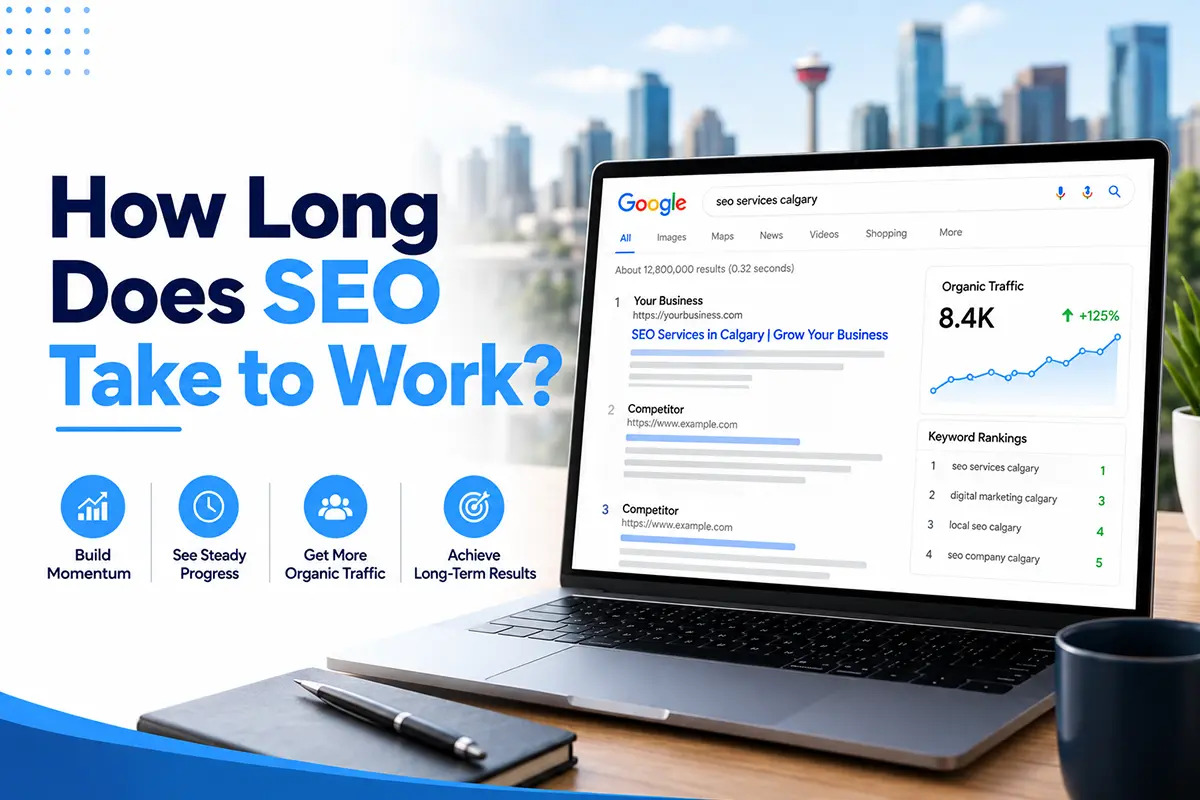
SEO usually takes 4 to 6 weeks to show first movement, about 3 months to bring a clear change in calls and leads, and 6 to 12 months to deliver its full benefit. Local searches and low-competition searches tend to move faster. Competitive searches, such as “furnace repair Calgary”, can take 6 to 12 months or longer.
Those numbers are ranges, not promises, and the real timeline for your business depends on a handful of things you can check yourself. This guide explains why SEO takes the time it does, what happens each month, what speeds it up and how to tell it is working before the leads arrive.
How long does SEO take, in short?
Plan for three stages. You will see early signs in the first six weeks, a real change in leads around month three, and steady growth from about month five. Here is the full picture.
| Stage | Typical timing | What you notice |
|---|---|---|
| Early signs | 4 to 6 weeks | More pages indexed, more impressions, first keyword gains |
| Clear change | Around month 3 | More calls and forms from search, easier keywords on page one |
| Steady growth | From Month 5 | Harder keywords start to move, lead volume builds |
| Full benefit | 6 to 12 months | Rankings hold, cost per lead falls, leads keep coming |
| Competitive searches | 8 to 12 months or more | Top spots in crowded markets |
Google’s own advice matches the longer end of this table. Maile Ohye, a Google Search Central speaker, said in Google’s video on hiring an SEO that it typically takes four months to a year to see the benefit after improvements are made. Some fixes, such as correcting a wrong Google Business Profile category, can register within weeks. Most of the gains that bring in steady leads take months.
Why does SEO take so long?
SEO takes time because Google has to find your changes, test them against other pages and build trust in your business before it moves you up. Three things slow it down, and none of them are in your control.
Google needs time to find and process changes. After you update a page or publish a new one, Google has to crawl it, index it and decide where it belongs. Then it watches how searchers respond.
Trust builds slowly. Google looks at links from other sites, mentions of your business, reviews and how long you have been active in your field. A new business with ten reviews cannot match a competitor with two hundred and six years of links in a few weeks.
Your competitors are not standing still. You are not ranking against a fixed target. Every business above you is also adding pages, reviews and links.
The research backs this up. An Ahrefs study of 2 million pages found that only 5.7% reached the top 10 within a year for at least one keyword, and the average page in the top 10 was more than two years old. That study is a few years old and covers all kinds of pages, including ones nobody tried to optimize. Treat it as a reminder that ranking takes time, not as a forecast for your business.
What affects how long SEO takes?
Eight things decide your timeline. Be honest about where you stand on each one.
| Factor | Faster | Slower |
|---|---|---|
| Competition | Small town, niche service | Large city, crowded trade |
| Keyword difficulty | Specific searches such as “garage door spring repair Okotoks” | Broad searches such as “garage door repair” |
| Site age and history | Established site with some links and reviews | New domain or a site with past penalties |
| Starting condition | Pages close to ranking, few technical errors | Slow site, broken pages, duplicate content |
| Content | One clear page per service and town | Thin pages or one page for everything |
| Authority | Reviews, local links and mentions already in place | Few reviews, no links |
| Google Business Profile | Verified, complete and active | Unclaimed, wrong category or suspended |
| Consistency | Steady work every month | Bursts of effort followed by silence |
A business with a verified profile, a decent site and three competitors in a small town can see movement in weeks. A new business in a crowded Calgary trade with a thin website is looking at the long end of the range. Neither is wrong. They are starting from different places.
What happens in each month of SEO?
Good SEO follows a sequence. Here is the order we work in for a typical Calgary service business, and when you should notice each part.
Week 1: audit and tracking
We check your site, your Google Business Profile and your competitors. We also set up call tracking, form tracking and Google Search Console so every result can be measured. Nothing is ranked yet, but this step decides whether you can prove what works later.
Weeks 2 to 6: foundation
We fix technical problems, map keywords to pages and improve the pages closest to ranking. Profile categories and service lists get corrected. First movement usually shows up in this window, often as more impressions and small gains on easier searches.
Months 2 to 4: build out
New service pages, town pages and helpful content go live. Internal links connect them. The first earned links and a steady flow of reviews start to arrive. Easier searches climb first, and calls from search usually start to rise around month three.
Month 5: growth
Harder searches begin to move. New content goes where the data points. The monthly report shifts from rankings to cost per lead and cost per booked job. One garage door repair client in Calgary started outside the top 25 on its main service searches, saw first movement in six weeks and reached the top 10 by month five.
Months 6 to 12: compounding
Pages that ranked early gain more authority, reviews build up and each new page starts from a stronger position than the last. This is where SEO usually becomes your lowest-cost source of leads, because the work keeps paying after the month it was done.
How long does local SEO take?
Local SEO often shows results faster than website SEO, because your Google Business Profile can move quickly once it is fixed. A corrected primary category or a cleaned-up profile can register within 2 to 4 weeks. More calls from the map usually follow in months 2 to 3, as reviews and weekly activity build.
How far you can reach depends on distance and competition. Google favours businesses close to the searcher, so a Calgary address will struggle to appear in the map in a town 30 minutes away. Pages on your website for each town you serve, plus reviews from those areas, help widen your reach over time. Our guides on how to rank in Google’s map pack in Calgary and Google Business Profile optimization explain each step. If you are new to the term, start with what local SEO is and why it matters for small businesses.
How long until a new website or page ranks?
A new page on an established site can start to rank for easy searches in a few weeks. A brand new website usually needs 6 to 12 months before it competes for anything difficult. Google’s John Mueller has said that rankings tend to swing more in a site’s first year, which is why new sites often seem to bounce around before they settle.
You can shorten the wait for a new site in three ways. Claim and verify your Google Business Profile on day one. Collect real reviews from the first customers. Target specific searches, such as a service in a named town, before you try for broad ones.
Does SEO take as long for AI Overviews and ChatGPT?
Yes, because getting named by AI tools depends on the same work as ranking in Google. Google’s guidance for site owners says there is no special markup or file needed to appear in its AI features, and that normal SEO practice applies. AI answers draw on pages that already rank well, your Google Business Profile, your reviews and what other sites say about you.
There is no fixed timeline for getting cited. What helps is the same list that helps rankings: clear answers near the top of each page, matching business details across the web, a steady flow of genuine reviews and pages search engines can read easily. Pew Research Center found that people clicked a regular link in 8% of visits when a Google AI summary appeared, compared with 15% when none did. That is a good reason to start building your profile, reviews and pages now, so the summaries get your details right.
How can you tell SEO is working before leads arrive?
You can see progress months before the phone rings more. Check these signs in your monthly report, and ask your SEO provider to show them.
- Impressions in Google Search Console are rising. This means Google is showing your pages to more people.
- More keywords sit in positions 11 to 30. These are the searches closest to page one.
- New pages are indexed. Pages that are not indexed cannot rank.
- Google Business Profile actions are rising. Calls, direction requests and website clicks from the profile show real interest.
- Branded searches grow. More people searching your business name means your name is spreading.
- Reviews arrive steadily. A flow of recent reviews is a sign the profile is healthy.
- Calls and forms from search increase. This is the number that matters most, and it usually moves last.
If you see none of these after three months, ask what has been done and why. A real plan has a clear answer.
How to speed up SEO results
No one can force Google to move faster, but you can remove the things that slow you down.
- Fix the basics first. A wrong profile category, a slow mobile site or broken pages hold back everything else.
- Target specific searches first. “Furnace repair Airdrie” is easier to win than “furnace repair” and often brings calls from people ready to hire.
- Give every service and town its own page. One page for six towns is the most common reason a business only gets calls from one.
- Ask every customer for a review. A steady flow of genuine reviews builds trust faster than almost anything else. Our guide on getting more Google reviews covers the rules.
- Keep your business details identical everywhere. Name, address and phone number should match on your website, profile and directories.
- Track calls and forms from week one. You can only improve what you measure.
- Stay consistent. SEO rewards steady monthly work and slows down when it stops.
Warning signs of a bad SEO timeline
Be careful with any provider who says any of the following.
- “Page one in 30 days.” Google does not sell rankings, so nobody can promise a result or a date.
- “Guaranteed number one.” The same applies. Google’s own guidance warns against anyone who guarantees a top ranking.
- A report with only keyword positions. Rankings do not pay bills. Ask for calls, forms and cost per lead.
- Bulk links or spun content. These can work for a short time and then lead to penalties.
- A long contract with no exit. If the work is good, you should be able to leave with 30 days notice and keep everything.
- No access to your accounts. Your website, analytics and Search Console should stay in your name.
SEO or Google Ads for faster results?
Google Ads is faster. SEO is slower but keeps working after you stop paying.
| Google Ads | SEO | |
|---|---|---|
| First calls | Within days | 4 to 6 weeks for first movement, around month 3 for a clear change |
| Cost over time | Stays the same or rises with competition | Usually falls as pages and reviews build |
| When you stop paying | Leads stop the same day | Rankings hold for months, then slowly slip |
| Best for | Filling the calendar this month | Keeping it full next year |
Most of our clients run both. Ads bring calls while the profile, pages and reviews build. As organic leads grow, ad spend can come down or move to the services and towns that still need it.
Frequently asked questions
How long does SEO take to work?
SEO usually shows first movement in 4 to 6 weeks, a clear change in leads around month 3, and steady growth from month 5. Google’s own advice puts the full benefit at four months to a year. Competitive searches can take 6 to 12 months or longer.
How long does it take to rank on the first page of Google?
For easier searches, such as a service in a small town, a few months. For competitive searches in a large city, 6 to 12 months or more. The time depends on your competition, your site’s history and how much trust your business has built through reviews and links.
How long does local SEO take?
Profile fixes such as a corrected category can register in 2 to 4 weeks. More calls from the map usually follow in months 2 to 3. Website pages for each town take longer, and results build over several months.
Can SEO work in 30 days?
You may see early signs in 30 days, such as more impressions, indexed pages or improved profile activity. A reliable change in leads usually takes about three months. Anyone who promises page one in 30 days is guessing or using a trick that can hurt you later.
Why is my SEO not working after three months?
Common causes are a weak starting site, too much competition for the searches you targeted, pages that are not indexed, missing tracking or inconsistent work. Check Google Search Console for impressions and indexed pages first, then ask your provider what was done each month.
Do I need to keep paying for SEO after I rank?
Rankings do not switch off the day you stop, but they slowly slip as competitors keep publishing and gathering reviews. SEO is always an ongoing task as far as you run your business. It is recommended to invest in SEO for a long period of time.
Is SEO faster than Google Ads?
No. Ads can bring calls within days, while SEO takes months. SEO usually costs less per lead over time and keeps working after you stop paying. Many businesses start with both.
How much does SEO cost?
Most small and mid-sized Calgary businesses spend between $1,000 and $2,500 a month on ongoing SEO. ClickSync plans start at $999 a month, with no setup fees and no contract. See the pricing page for what each plan includes.
Want to know where your SEO stands?
ClickSync Marketing offers a free audit. We look at your rankings, your Google Business Profile and your call tracking, then send you the three fixes we would make first and a realistic timeline for your market. You keep the audit whether or not you hire us. Book a free strategy session or call 403 498 9875. You can also read about our SEO services in Calgary.