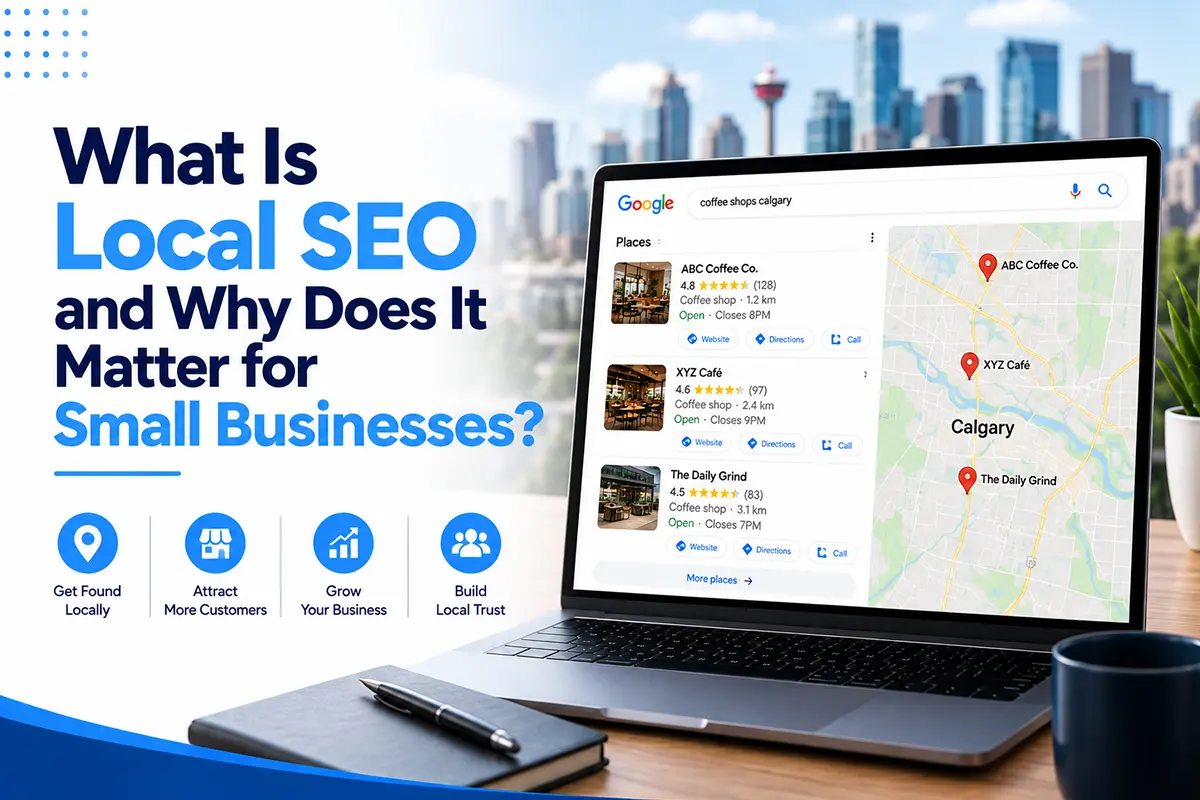
Local SEO is the work of making your business easy to find when people search for something nearby. It decides whether you appear in Google Maps, in the local results at the top of the page, and in the answers AI tools give. For small businesses that live on calls, visits and bookings, it is one of the most affordable ways to reach people who are ready to buy.
This guide explains what local SEO is, how Google picks which businesses to show, what the work involves, how long it takes and what it costs. It is written for business owners, so you can decide what to do yourself and what to hand off.
What is local SEO?
Local SEO, short for local search engine optimization, is the process of improving how visible your business is in searches tied to a place. That includes searches with a town in them, such as “furnace repair Airdrie”, and searches where Google uses the searcher’s location, such as “coffee shop near me”. The work covers your Google Business Profile, your reviews, your website pages, your listings on other sites and the way your business details appear across the web.
The goal is simple. When a nearby customer searches for what you sell, your business appears with a clear name, a good rating, correct hours and a way to call or get directions. Local SEO is built for businesses that serve customers in a specific area, such as trades, clinics, restaurants, auto shops, law firms and retail stores. It works for businesses with a storefront and for service area businesses that travel to the customer.
How is local SEO different from regular SEO?
Regular SEO helps your website rank for searches from anyone, anywhere. Local SEO helps your business show up for people who are near you, and it leans heavily on your Google Business Profile and reviews instead of only on your website.
| Regular SEO | Local SEO | |
|---|---|---|
| Main goal | Rank web pages for a topic | Show your business to nearby searchers |
| Where results appear | Standard blue link results | Map pack, Google Maps, local results and AI answers |
| Biggest signals | Content quality, site health, links | Google Business Profile, reviews, location and consistent business details |
| Best suited to | Any business | Businesses with a location or a service area |
| What you measure | Visits and rankings | Calls, direction requests and bookings |
Most local businesses need both. Local SEO gets you into the map. Regular SEO builds the website pages that back it up. Our SEO services in Calgary cover the website side, and our Google Business Profile management covers the listing itself.
Why does local SEO matter for small businesses?
Local SEO matters because people check you online before they contact you, and the businesses they see first usually get the call. Four things make that especially true for small businesses right now.
People read reviews before they choose
BrightLocal’s 2026 Local Consumer Review Survey found that 97% of consumers read reviews for local businesses, and 41% always read them before choosing, up from 29% the year before. A business with few or old reviews loses ground to one with a steady flow of recent ones, even when the work is equally good.
The map gets the first look
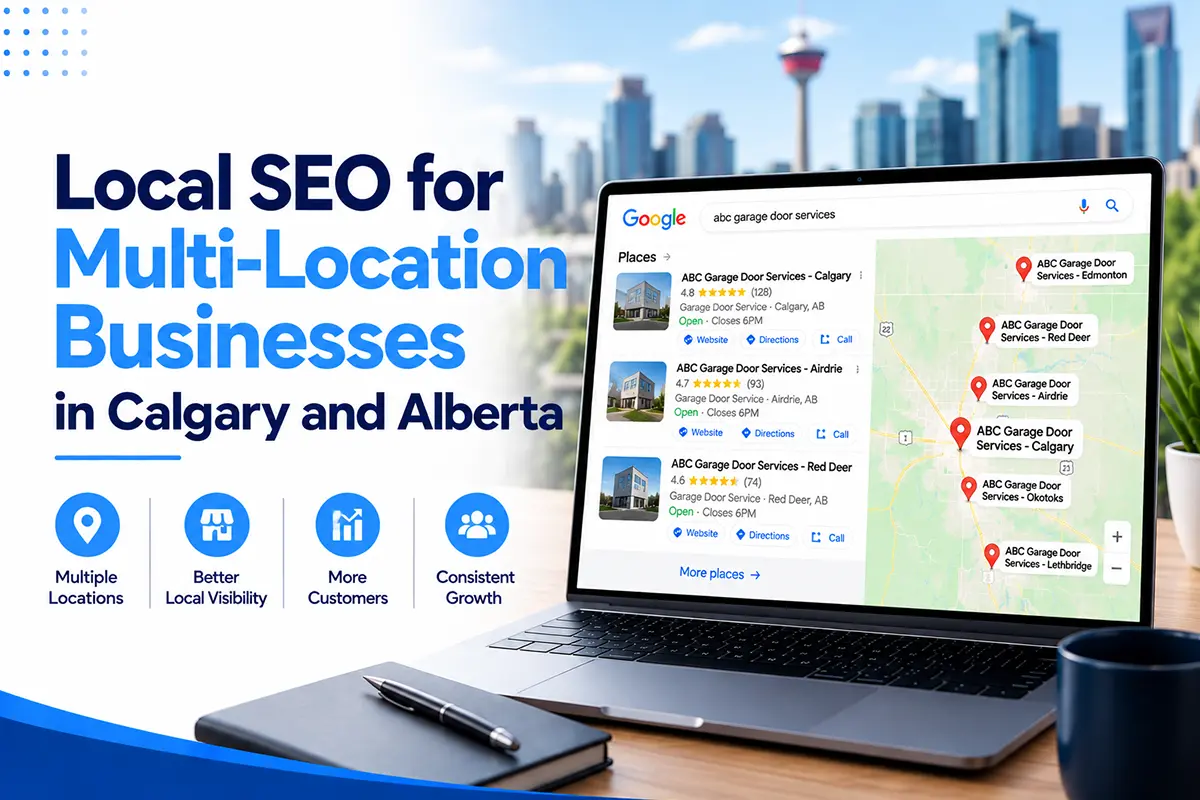
On most local searches, Google shows three businesses on a map above the regular results. This is the map pack, and it pulls its information from Google Business Profiles. Many of the businesses we work with get more calls from the map than from paid search. One appliance repair client serving Calgary and Airdrie reached more than 30 calls a month from the map, and those calls passed paid search within a quarter after we rebuilt the profile and fixed its categories.
Many competitors have not done the basics
BrightLocal research cited alongside its 2026 survey suggests that only 35% of small businesses have a Google Business Profile. A complete, active profile puts you ahead of a large share of the businesses you compete with.
It keeps working when the budget stops
Google Ads stop sending calls the day you stop paying. A verified profile, a library of reviews and well-built service pages stay in your name and keep working. That is why we usually run local SEO next to ads and not instead of them.
How does Google decide which local businesses to show?
Google says local results are based mainly on three factors: relevance, distance and prominence. Everything else you read about local ranking sits under one of those three.
- Relevance is how well your profile matches what the person searched. Your primary category, your list of services, your description and the words in your reviews all feed it.
- Distance is how close you are to the searcher, or to the place they typed into the search.
- Prominence is how well known and trusted your business looks. Review count, review quality, recent activity, links and mentions from other sites all count.
You cannot move your building, so local SEO focuses on the two factors you can change: relevance and prominence. Distance also explains something that surprises many owners. There is no single map result for a city. The three businesses shown change with where the searcher is standing, so a business that wins in one neighbourhood can be invisible five kilometres away. Our guide on how to rank in Google’s map pack in Calgary explains how to work around that.
What does local SEO include?
Good local SEO is six pieces of work that support each other.
Your Google Business Profile
This is the free listing that appears in Google Maps and the map pack. The biggest single choice is your primary category, because it tells Google what your business is. After that come your services, hours, service area, photos and description. Our Google Business Profile optimization guide walks through each step in order.
Reviews
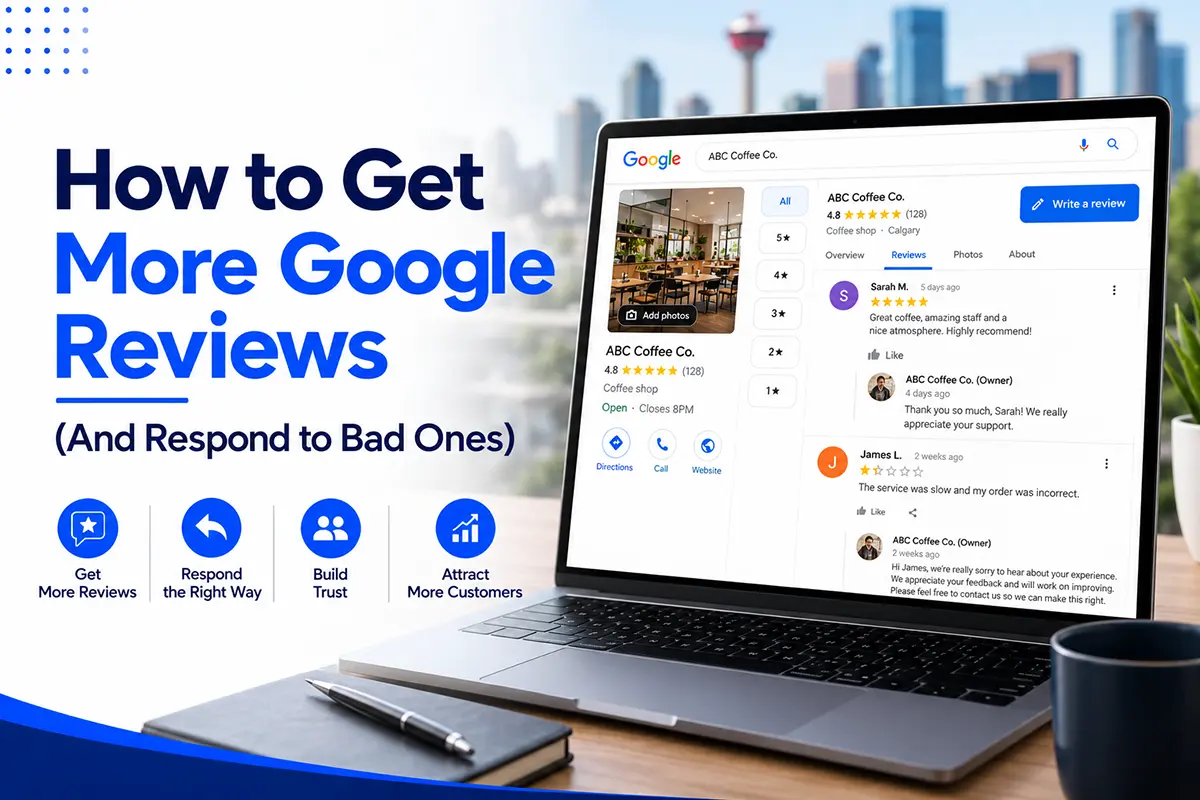
Reviews help you rank and help people decide. What works is a simple request sent to every customer after the job, a reply to every review, and no incentives. Google’s rules on review gating and rewards are strict, and Canadian anti-spam law applies when you text or email customers. We cover both in our guide to getting more Google reviews.
Website pages that match local searches
Your profile links to your website, and Google checks that the two agree. That means one clear page for each service, and a separate page for each town you serve instead of one page aimed at the word “Calgary”. A searcher in Okotoks and a searcher in Chestermere type different things, and Google treats them as different markets.
Consistent business details
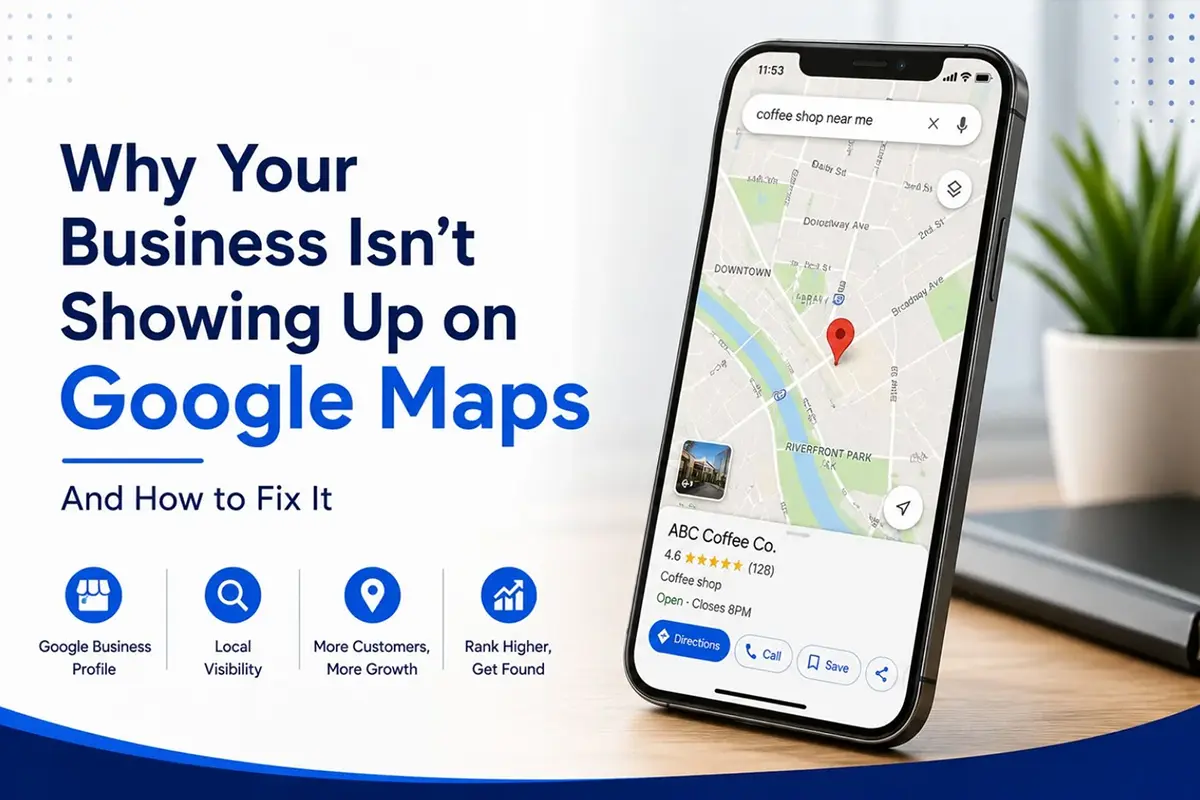
Your business name, address and phone number should read the same on your website, your profile, Facebook and every directory. A phone number left over from three years ago on one listing is enough to weaken trust. If your listing is missing or buried, start with our checklist on why your business isn’t showing up on Google Maps.
Local links and mentions
Links and mentions from suppliers, trade associations, local news, sponsorships and community groups show Google that your business is real and known in your area. This is the slowest part to build and the hardest for a competitor to copy.
Tracking
If you cannot see which calls and forms come from your profile and website, you cannot tell what is working. Track calls, form submissions, website clicks and direction requests from the start, and judge the work by booked jobs and not by views.
Does local SEO help you show up in AI Overviews and ChatGPT?
Yes, indirectly. AI tools answer questions like “who should I call for a leaking water heater?” using the same material people read: your Google Business Profile, your reviews, your website and your listings on other sites. BrightLocal’s 2026 survey found that AI tools such as ChatGPT have moved into third place for local business recommendations, behind Google and Facebook.
Google’s own guidance for site owners says there is no special file or markup needed to appear in its AI features, and that normal SEO practice applies. In plain terms, the work that helps you rank also helps you get named. These are the parts worth getting right:
- Keep your name, address, phone number, hours and services identical everywhere they appear.
- Answer common customer questions on your service pages, in plain words, near the top of the page.
- Ask every customer for a review, and reply with the service and area mentioned, so the AI has real detail to repeat.
- Make sure the main content of your pages loads as normal text so search engines and AI crawlers can read it.
There is a reason to take this seriously. Pew Research Center’s March 2025 analysis of US browsing data found that people clicked a regular result link in 8% of visits when a Google AI summary appeared, compared with 15% when none did. That covers all kinds of searches, so treat it as a direction and not a forecast for your trade. It does mean your profile, reviews and website need to be complete enough that anything summarizing your business gets the facts right.
How long does local SEO take?
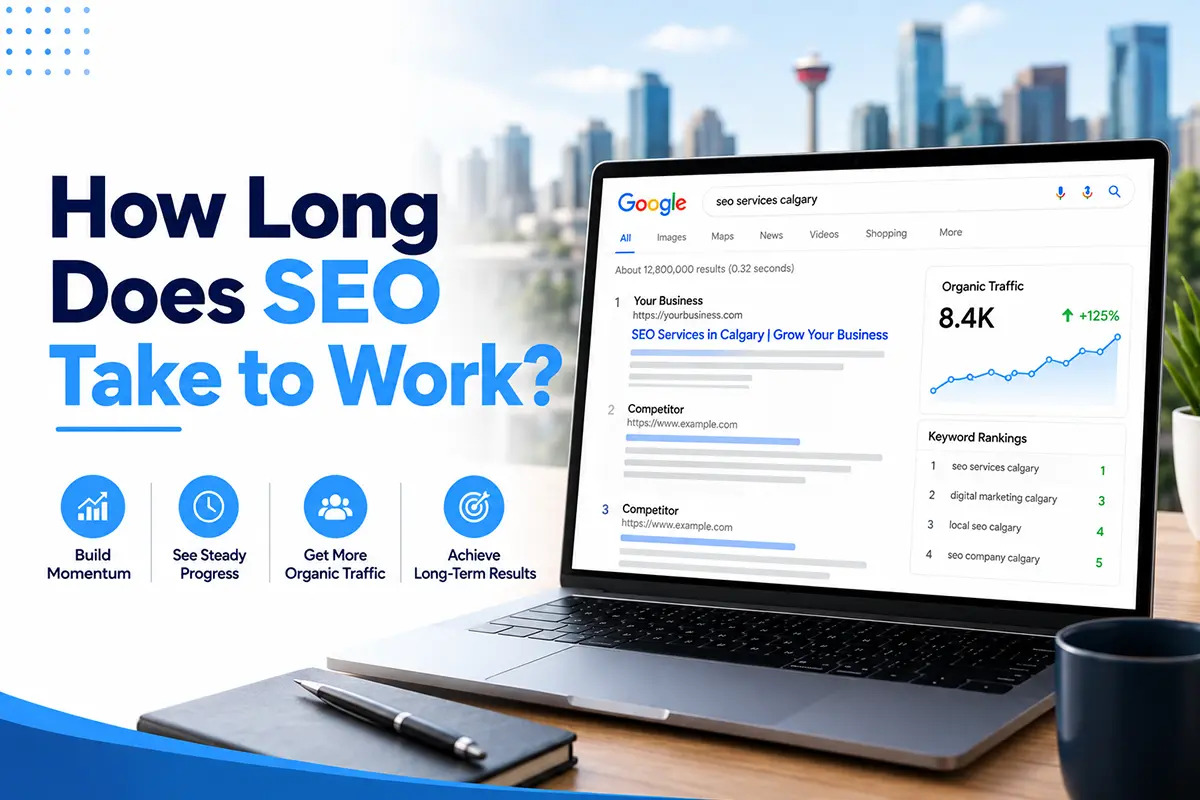
Local SEO takes a few weeks to show first movement and about three months to bring a clear change in calls. Profile work moves faster than website work, and less competitive searches move before competitive ones.
| Work | Typical timing |
|---|---|
| Fixing categories and profile details | 2 to 4 weeks |
| More calls from the map | Months 2 to 3 |
| First movement in website rankings | Around week 6 |
| Meaningful organic volume | Around month 3 |
| Competitive searches such as “furnace repair Calgary” | 6 to 12 months or longer |
These are the ranges we see in client work, not guarantees. Google does not sell rankings, so be careful with anyone who promises first place in 30 days.
How much does local SEO cost?
You can do the basics for free, because a Google Business Profile costs nothing. If you pay for help, most small and mid-sized Calgary businesses spend between $1,000 and $2,500 a month on ongoing SEO, based on what we see in this market. A $300 a month package usually pays for a ranking report and very little real work.
ClickSync plans start at $999 a month and include Google Business Profile management, Google Ads management, lead tracking and monthly reporting. There are no setup fees and no long contract. You cancel with 30 days notice, and the website, profile and ad accounts stay in your name. You can see every plan on our pricing page.
Is local SEO right for your business?
Local SEO works well if:
- Your customers search Google before they hire someone like you.
- You have a real address, or you drive to customers from a real base.
- Someone answers the phone or the booking form during your posted hours.
- A new customer is worth enough to invest for a few months.
Local SEO is the wrong fit if:
- You only have a virtual office or a mailbox. Google suspends those listings.
- You need the calendar full this week. That is a job for ads.
- You want guaranteed rankings, bought reviews or keywords added to your business name. All three break Google’s rules or promise what nobody can deliver.
Common local SEO mistakes
These come up again and again when we audit small business profiles.
- A primary category that is too broad. “General contractor” loses to “Garage door supplier” for a garage door search.
- Business details that do not match. An old suite number or phone number on one directory weakens trust in all of them.
- A profile that was set up once and left alone. New photos, updated services and review replies keep it active.
- Asking only happy customers for reviews, or offering a discount for one. Both break Google’s rules and can get reviews removed.
- One “Calgary” page for six towns. This is the most common reason a business with trucks in several towns only gets calls from one.
- Keywords added to the business name. It can get the profile suspended.
- Checking rankings from your own office. You may rank first at your desk and not at all six kilometres away, where half your customers live.
How to start local SEO this week
You can make real progress in a few hours. Work through these steps in order.
- Claim and verify your Google Business Profile. Search your business name on Google and Maps to see if a listing already exists.
- Pick the most specific primary category that is accurate. Add secondary categories for your other real services.
- Match your name, address and phone number everywhere. Check your website, Facebook and your top directory listings, and fix anything that differs.
- List every service with a short description. Break “plumbing” into drain cleaning, water heater installation, leak repair and the rest.
- Ask recent customers for a review with a direct link. In Canada, make sure you have consent before you text or email, and include a way to opt out.
- Build a page for each main service and each town you serve. Put your real prices, photos of your work and answers to common questions on it.
- Set up call and form tracking. Without it you are guessing which work pays off.
If that list feels like more than you have time for, our free audit shows where you stand and which three fixes to make first.
Local SEO or Google Ads?
Ads bring calls within days and stop the day you stop paying. Local SEO takes longer and keeps working after the invoice is paid. If you need work booked this month, start with ads. If you can wait a few months, local SEO costs less per lead over time. Most of our clients run both, with ads covering the gap while the profile, reviews and pages build.
Frequently asked questions
What is local SEO in simple terms?
Local SEO is how you help nearby customers find your business online. It means setting up and maintaining your Google Business Profile, collecting reviews, keeping your details consistent across the web and building website pages for the services and towns you cover. The aim is to appear when someone nearby searches for what you sell.
What is the difference between SEO and local SEO?
SEO is the work that helps your website rank in the regular search results. Local SEO adds the map results, your Google Business Profile, reviews and town pages. Regular SEO aims for visits to your website, while local SEO aims for calls, direction requests and bookings from people near you.
Is a Google Business Profile the same as local SEO?
No. A Google Business Profile is the largest single part of local SEO, but not the whole of it. Local SEO also covers your reviews, your website pages, your listings on other sites and your tracking. A strong profile on a weak website tends to stall.
Can I do local SEO myself?
Yes, the basics are free and manageable for most owners. Claiming your profile, choosing the right category, matching your business details and asking for reviews can all be done in a few hours. Many owners hand it off when the weekly work of photos, review replies and new pages stops fitting between jobs. But a professional Local SEO Agency like ClickSync Marketing can help you to gain more of it to increase your revenue.
Does local SEO work for businesses that travel to customers?
Yes. Service area businesses can hide their street address and list the towns they serve. You still need a real base, because Google suspends virtual offices and mailboxes. Add a page on your website for each town, since Google favours businesses close to the searcher.
Do reviews affect local SEO?
Yes. Reviews are part of prominence, one of Google’s three local ranking factors. Review count, recency, rating and your replies all matter. What counts is a steady flow of genuine reviews from real customers, not a burst followed by months of silence.
How long does local SEO take to work?
Most businesses see profile changes register within 2 to 4 weeks and more calls from the map in months 2 to 3. Website rankings usually start to move around week 6. Competitive searches can take 6 to 12 months or longer.
Want to know where your business stands?
ClickSync Marketing offers a free audit. We look at your Google Business Profile, your rankings and your call tracking, then send you the three fixes we would make first. You keep the audit whether or not you hire us. Book a free strategy session or call 403 498 9875.