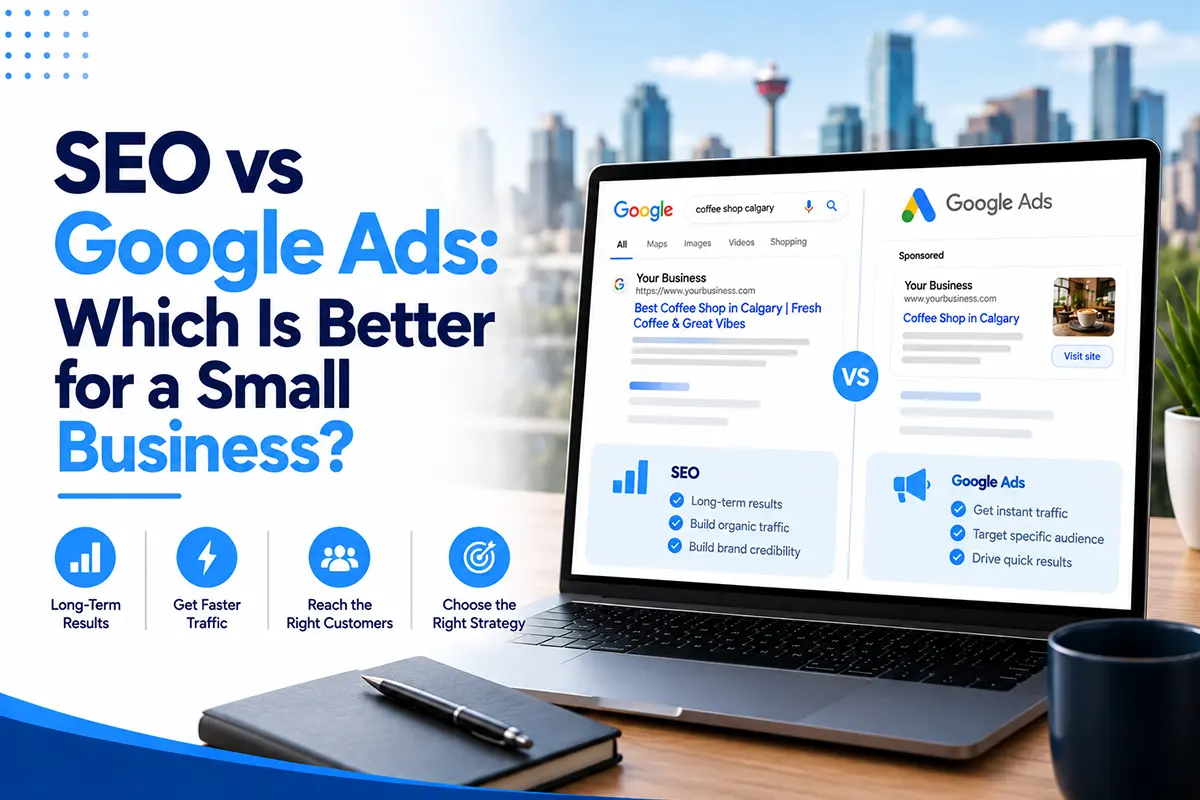
Neither one is better for every small business. Google Ads is better when you need calls this month, because ads can bring leads within days. SEO is better when you want steady leads at a lower cost over time, because it takes months to build and keeps working after you stop paying. Most local businesses do best with both, starting with ads if cash flow needs leads now and SEO if they are building for the next year.
We run both for Calgary and Alberta businesses, so this guide is based on what we see in real accounts and on published benchmarks. Where a number comes from a study, we link to it so you can check it.
SEO vs Google Ads
| SEO | Google Ads | |
| Speed | First movement in 4 to 6 weeks, clear results around after month 6 | Clicks and calls can start within days |
| How you pay | A monthly fee for the work, no cost per click | Ad spend for every click, plus a management fee if you hire help |
| If you stop | Pages keep ranking for a while, then slowly slip without upkeep | Leads stop the day the budget stops |
| Cost over time | Cost per lead usually falls as pages and reviews build up | Cost per lead stays roughly flat and can rise as competition grows |
| Control | Less control, since Google decides rankings | High control over budget, location, hours and keywords |
| Best for | Steady, lower-cost leads and long-term trust | Fast leads, new offers, seasonal pushes and testing |
| Main risk | Slow start and results that are hard to promise | Wasted spend on a weak site or poor tracking |
What is the difference between SEO and Google Ads?
SEO (search engine optimization) is the work of improving your website and Google Business Profile so you appear in the free, unpaid results. You do not pay Google when someone clicks.
Google Ads is paid advertising. You bid on searches such as “furnace repair Calgary”, and your ad shows above or below the free results. You pay each time someone clicks, which is called pay per click (PPC).
Both start with the same thing: a person typing a search when they have a problem to solve. The difference is how you earn the spot. With SEO you earn it over time. With ads you buy it, one click at a time. You can read more in our guides to SEO and Google Ads
Which one is faster?
Google Ads is faster. A well-built campaign can bring calls within days of launch. SEO usually shows first movement in four to six weeks and a clear change in calls around month three. Competitive searches can take six to twelve months. Our guide on how long SEO takes to work explains what moves first.
If you have a slow week and bills due, ads solve that problem faster. If you can wait a few months for steady growth, SEO costs less per lead in the long run.
Which one costs more?
They cost money in different ways, so compare cost per lead, not the monthly fee.
SEO is a monthly fee for the work. Most small businesses in Canada pay between $1,000 and $3,000 a month, and ClickSync plans start at $999. We break down every price range in our guide to how much SEO costs in Canada.
Google Ads has two costs: the ad spend that goes to Google, and the fee for whoever manages the account. The ad spend depends on your industry. These are 2026 US benchmarks from WordStream and LocaliQ, shown in US dollars. Use them as a guide, since your city and competition change the numbers.
| Industry | Average cost per click | Average cost per lead |
| All industries | $5.42 | $66.69 |
| Attorneys and legal services | $9.87 | $131.63 |
| Home and home improvement | $8.33 | Varies by trade |
| Dentists and dental services | $8.00 | Varies by practice |
Source: WordStream and LocaliQ 2026 search benchmarks, as summarized by Webtonic.
Here is why cost per lead matters. The example below uses made-up numbers to show the pattern, not a promise of results.
| Month | SEO at $1,500 a month | Google Ads at $1,500 ad spend |
| Month 1 | 0 to 2 leads, mostly setup work | 15 to 20 leads, about $75 to $100 each |
| Month 3 | 5 leads, about $300 each | 20 leads, about $75 each |
| Month 6 | 20 leads, about $75 each | 20 leads, about $75 each |
| Month 12 | 35 leads, about $43 each | 20 leads, about $75 each |
Ads win the first few months. SEO wins later, because the pages, reviews and rankings you built keep bringing in calls without a charge for each click. This is why many businesses run both.
What happens when you stop paying?
With Google Ads, your ads stop the day your budget stops. Your leads stop with them.
With SEO, the pages and rankings you built stay in place. They can slip over time if nobody updates content, collects reviews or fixes problems, but they do not vanish overnight. This is the biggest reason SEO is often called an asset and ads are called a utility.
Is search still worth it with AI Overviews?
Yes, especially for local searches, but clicks are changing. A SparkToro study found that 68% of US Google searches ended without a click in early 2026, and that AI Overviews cut click-through rates by roughly 60% on the results where they appear. The same report says local business queries and high-intent searches are less affected than informational ones. You can read the summary on Search Engine Land.
Ads are affected too. Seer Interactive found paid click-through rates fell 68% on informational queries with AI Overviews. Its data also shows brands cited in AI Overviews earned more clicks on both their organic listings and their ads, which means the two channels help each other. See the Seer Interactive study coverage.
For a local business, the practical point is this. People who search “dentist near me” or “plumber Calgary” are ready to call, and they often see the map results first. A strong Google Business Profile and good reviews matter as much as your website. Read our guides on ranking in the Map Pack and Google Business Profile optimization.
Which one should your business choose?
Use your situation to decide. These are starting points, not rules.
| Your situation | Start with | Why |
| You need leads in the next 30 days | Google Ads | SEO is too slow for an urgent gap |
| Emergency services such as plumbing, towing or locksmith | Both, ads first | People search when it is urgent and call the first option they see |
| New business with no website history | Ads plus SEO basics | Ads bring early calls while the new site builds trust |
| Seasonal business with a short peak | Google Ads | You can switch ads on and off to match demand |
| Long-term growth with a steady budget | SEO | Cost per lead drops over time |
| High-value jobs and a long decision time | SEO plus ads | Content builds trust before the call, ads catch ready buyers |
| Very tight budget under $1,000 a month | Google Business Profile and basic SEO | Free local visibility first, ads once the site converts |
| Very competitive, expensive clicks | SEO plus targeted ads | Ads on narrow, high-intent searches only |
How to use SEO and Google Ads together
The two channels support each other when you plan them as one system.
- Use ad data to guide SEO. Ads show you which searches bring calls. Build service pages around the ones that convert.
- Use SEO pages as ad landing pages. Google rates landing page experience as part of how it scores ads, so a fast, clear page can lower your costs.
- Cover brand searches. When someone searches your business name, make sure your listing, website and profile all appear.
- Shift the mix over time. Start with more ad spend, then move budget toward SEO as organic calls grow.
- Share reviews and trust signals. Reviews, photos and clear pricing help both your listing and your ad page.
- Track every call and form. One set of reports lets you compare the cost per lead of each channel honestly.
As a starting example, a business that needs leads now might put about 70% of its budget into ads and 30% into SEO foundations for the first three months, then move closer to an even split. The right mix depends on your market, so treat this as a starting point to adjust, not a formula.
What mistakes should you avoid?
- Sending ad traffic to a weak website. A slow or confusing page wastes every click. Our website design and development service fixes this.
- Skipping conversion tracking. If you cannot see calls and form fills, you cannot tell what is working.
- Bidding on broad keywords. “Plumber” brings browsers. “Emergency plumber Calgary” brings callers.
- Forgetting negative keywords. Without them, your ads show for searches such as jobs, free advice or DIY.
- Judging SEO after 30 days. Give it at least three months before you decide.
- Pausing ads at the first slow week. Ad platforms need time to learn, and stopping resets progress.
- Ignoring your Google Business Profile. For local searches it often decides who gets the call.
- Choosing based on price alone. The cheapest plan is rarely the lowest cost per lead.
Quick decision checklist
Answer these five questions.
- Do I need leads within 30 days? If yes, start with Google Ads.
- Can I wait three to six months for steady growth? If yes, put real budget into SEO.
- Is my website fast, clear and easy to use on a phone? If not, fix it before spending on either.
- Can I track calls and forms? If not, set that up first.
- Do I have a verified Google Business Profile with reviews? If not, do that this week.
If you are starting a new site, our SEO checklist for new small business websites covers the basics in order.
Frequently asked questions
Is SEO better than Google Ads for small business?
It depends on your goal. SEO gives lower cost per lead over time and builds a lasting asset. Google Ads gives faster leads and more control. Many small businesses start with ads for quick calls and build SEO behind them.
Is SEO cheaper than Google Ads?
Over a year or more, usually yes, because you do not pay for each click. In the first few months ads often cost less per lead, because SEO is still building. Compare cost per lead across at least six months before you decide.
Can I do both SEO and Google Ads?
Yes, and many businesses should. Ads bring fast leads and show which searches convert. SEO builds steady results behind them. The two also support each other through shared pages, reviews and tracking.
How much should a small business spend on Google Ads?
It depends on your industry and city. US benchmarks put the average click at about $5.42, and costs run higher for legal, home services and dental. A budget that buys enough clicks to produce 10 to 20 leads a month is a reasonable starting point for many local businesses.
How long before Google Ads work?
You can see clicks and calls within days. Most campaigns need two to three months of adjustment to lower the cost per lead, because the platform and your keywords need data.
Do Google Ads help SEO rankings?
Not directly. Google says ads do not affect organic rankings. Ads do help SEO indirectly, since the data shows which searches convert and more brand searches can follow.
Which is better for a local business in Calgary?
Most Calgary service businesses do best with a strong Google Business Profile, local SEO and a focused Google Ads campaign on high-intent searches. We tailor the mix to your market, budget and goals.
What if I can only afford one?
If you need leads now, choose ads. If you can wait and want lower costs later, choose SEO and start with your Google Business Profile, which is free. Whichever you pick, make sure the website and tracking are ready.
Not sure which one fits your business?
We can look at your market, your website and your budget, and show you the mix we would choose. You get a plain-language plan with costs, and you keep it whether or not you hire us.
Book a free strategy session or call 403 498 9875.
You can also explore our SEO services in Calgary, our Google Ads management and our pricing.